Showing posts with label Scouting. Show all posts

Friday, 3 July 2020

Pea leaf weevil

Pea Leaf Weevil (Sitona lineatus) –  Models runs predicting spring adult activity, oviposition and larval development for this pest are completed as of Week 9 (June 21, 2020).  Use the following information to aid in-field scouting for larvae.

The pea leaf weevil is a slender greyish-brown insect measuring approximately 5 mm in length (Fig. 1, Left image). Pea leaf weevil resembles the sweet clover weevil (Sitona cylindricollis) but the former is distinguished by three light-coloured stripes extending length-wise down thorax and sometimes the abdomen.  All species of Sitona, including the pea leaf weevil, have a short snout.  


Figure 1.  Comparison images and descriptions of four Sitona species adults including pea leaf weevil (Left).

Adults will feed upon the leaf margins and growing points of legume seedlings (alfalfa, clover, dry beans, faba beans, peas) and produce a characteristic, scalloped (notched) edge.  Females lay 1000 to 1500 eggs in the soil either near or on developing pea or faba bean plants from May to June.


Larvae develop under the soil and are “C” shaped and milky-white with a dark-brown head capsule ranging in length from 3.5-5.5 mm (Figure 2).  Larvae develop through five instar stages.  After hatching, larvae seek and enter the roots of a pea plant.  Larvae will enter and consume the contents of the nodules of the legume host plant. It is the nodules that are responsible for nitrogen-fixation which affect yield plus the plant’s ability to input nitrogen into the soil. Consumption of or damage to the nodules (Figure 3) results in partial or complete inhibition of nitrogen fixation by the plant and results in poor plant growth and low seed yields.


Figure 2. Weevil larva in soil (Photo: L. Dosdall).


Figure 3. Pea nodules damaged by larval feeding (Photo: L. Dosdall).

Biological and monitoring information related to pea leaf weevil in field crops is posted by the province of Alberta and in the PPMN monitoring protocol.

Also refer to the pea leaf weevil page within the "Field Crop and Forage Pests and their Natural Enemies in Western Canada: Identification and management field guide" - both English-enhanced or French-enhanced versions are available. 

Thursday, 25 June 2020

Predicted pea leaf weevil development

Pea Leaf Weevil (Sitona lineatus) –  As of June 21, 2020, model runs for pea leaf weevil (PLW) indicate that oviposition has peaked at Swift Current and Lacombe.  The following two graphs illustrate that larval numbers continue to increase at Swift Current and Lacombe as the eggs continue to hatch.
Figure 1. Predicted pea leaf weevil (Sitona lineatus) phenology at Swift Current SK.
Values are based on model simulations (April 1-June 21, 2020).

Figure 2. Predicted pea leaf weevil (Sitona lineatus) phenology at Lacombe AB.
Values are based on model simulations (April 1-June 21, 2020).

Pea leaf weevils emerge in the spring primarily by flying (at temperatures above 17 ÂșC) or they may walk short distances. Pea leaf weevil movement into peas and faba beans is achieved primarily through flight.  Adults are slender, greyish-brown measuring approximately 5 mm in length (Fig. 3, Left).  

The pea leaf weevil resembles the sweet clover weevil (Sitona cylindricollis) but the former is distinguished by three light-coloured stripes extending length-wise down thorax and sometimes the abdomen.  All species of Sitona, including the pea leaf weevil, have a short snout.  


Figure 3.  Comparison images and descriptions of four Sitona species adults including pea leaf weevil (Left).

Adults will feed upon the leaf margins and growing points of legume seedlings (alfalfa, clover, dry beans, faba beans, peas) and produce a characteristic, scalloped (notched) edge.  Females lay 1000 to 1500 eggs in the soil either near or on developing pea or faba bean plants from May to June.


Larvae develop under the soil and are “C” shaped and milky-white with a dark-brown head capsule ranging in length from 3.5-5.5 mm (Figure 4).  Larvae develop through five instar stages.  After hatching, larvae seek and enter the roots of a pea plant.  Larvae will enter and consume the contents of the nodules of the legume host plant. It is the nodules that are responsible for nitrogen-fixation which affect yield plus the plant’s ability to input nitrogen into the soil. Consumption of or damage to the nodules (Figure 5) results in partial or complete inhibition of nitrogen fixation by the plant and results in poor plant growth and low seed yields.


Figure 4. Weevil larva in soil (Photo: L. Dosdall).


Figure 5. Pea nodules damaged by larval feeding (Photo: L. Dosdall).

Biological and monitoring information related to pea leaf weevil in field crops is posted by the province of Alberta and in the PPMN monitoring protocol.

Also refer to the pea leaf weevil page within the "Field Crop and Forage Pests and their Natural Enemies in Western Canada: Identification and management field guide" - both English-enhanced or French-enhanced versions are available. 

Friday, 19 June 2020

Predicted pea leaf weevil development

Pea Leaf Weevil (Sitona lineatus) –  As of June 14, 2020, PLW model runs indicate that PLW females continue to oviposit eggs.  The following two graphs illustrate that egg numbers continue to increase at Swift Current (Fig. 1) and Lacombe (Fig. 2).  This week, first appearance of PLW larvae is expected to occur at Swift Current (Fig. 1). 


Figure 1. Predicted pea leaf weevil (Sitona lineatus) phenology at Swift Current SK.
Values are based on model simulations (April 1-June 14 2020).


Figure 2. Predicted pea leaf weevil (Sitona lineatus) phenology at Lacombe AB.
Values are based on model simulations (April 1-June 14 2020).

Link here to access photos of PLW and related species of weevils which can all be active simultaneously in Canadian prairie field crops. 

Biological and monitoring information related to pea leaf weevil in field crops is posted by the province of Alberta and in the PPMN monitoring protocol.

Also refer to the pea leaf weevil page within the "Field Crop and Forage Pests and their Natural Enemies in Western Canada: Identification and management field guide" - both English-enhanced or French-enhanced versions are available. 

Friday, 12 June 2020

Predicted pea leaf weevil development

Pea Leaf Weevil (Sitona lineatus) –  As of June 7, 2020, the PLW phenology model indicates that females continue to lay eggs. The following two graphs illustrate the pattern of PLW oviposition for Swift Current and Lacombe. 


Figure 1. Predicted pea leaf weevil (Sitona lineatus) phenology at Swift Current SK.
Values are based on model simulations (April 1-June 7, 2020).


Figure 1. Predicted pea leaf weevil (Sitona lineatus) phenology at Lacombe AB.
Values are based on model simulations (April 1-June 7, 2020).

Link here to access photos of PLW and related species of weevils which can all be active simultaneously in Canadian prairie field crops. 

Biological and monitoring information related to pea leaf weevil in field crops is posted by the province of Alberta and in the PPMN monitoring protocol.

Also refer to the pea leaf weevil page within the "Field Crop and Forage Pests and their Natural Enemies in Western Canada: Identification and management field guide" - both English-enhanced or French-enhanced versions are available. 

Thursday, 4 June 2020

Predicted pea leaf weevil development

Pea Leaf Weevil (Sitona lineatus) –  The phenology model for pea leaf weevil (PLW) indicates that females recently started to lay eggs (if they are present in those regions). The following two graphs illustrate the pattern of PLW oviposition for Swift Current (Fig. 1) and Lacombe (Fig. 2). 
Figure 1. Predicted pea leaf weevil (Sitona lineatus) phenology at Swift Current SK.
Values are based on model simulations (April 1-May 31, 2020).

Figure 2. Predicted pea leaf weevil (Sitona lineatus) phenology at Lacombe AB.
Values are based on model simulations (April 1-May 31, 2020).

Link here to access photos of PLW and related species of weevils which can all be active simultaneously in Canadian prairie field crops. Also access the 2019 prairie-wide distribution map for this pest at this link.

Biological and monitoring information related to pea leaf weevil in field crops is posted by the province of Alberta and in the PPMN monitoring protocol.

Also refer to the pea leaf weevil page within the "Field Crop and Forage Pests and their Natural Enemies in Western Canada: Identification and management field guide" - both English-enhanced or French-enhanced versions are available. 

Monday, 1 June 2020

Pest Alert

Important for scouting this week - Click to access two updates related to in-field scouting released June 2!
  • The predicted emergence of the first Bertha armyworm of 2020 across the Canadian prairies  (which helps time the deployment of pheromone traps).
  • Predicted development of alfalfa weevil to help time in-field scouting for damaging larval stages of Alfalfa weevil.

Thursday, 28 May 2020

Pea leaf weevil

Pea Leaf Weevil (Sitona lineatus) –  Pea leaf weevils emerge in the spring primarily by flying (at temperatures above 17 ÂșC) or they may walk short distances. Pea leaf weevil movement into peas and faba beans is achieved primarily through flight.  Adults are slender, greyish-brown measuring approximately 5 mm in length (Fig. 1, Left).  

The pea leaf weevil resembles the sweet clover weevil (Sitona cylindricollis) but the former is distinguished by three light-coloured stripes extending length-wise down thorax and sometimes the abdomen.  All species of Sitona, including the pea leaf weevil, have a short snout.  


Figure 1.  Comparison images and descriptions of four Sitona species adults including pea leaf weevil (Left).

Adults will feed upon the leaf margins and growing points of legume seedlings (alfalfa, clover, dry beans, faba beans, peas) and produce a characteristic, scalloped (notched) edge.  Females lay 1000 to 1500 eggs in the soil either near or on developing pea or faba bean plants from May to June.


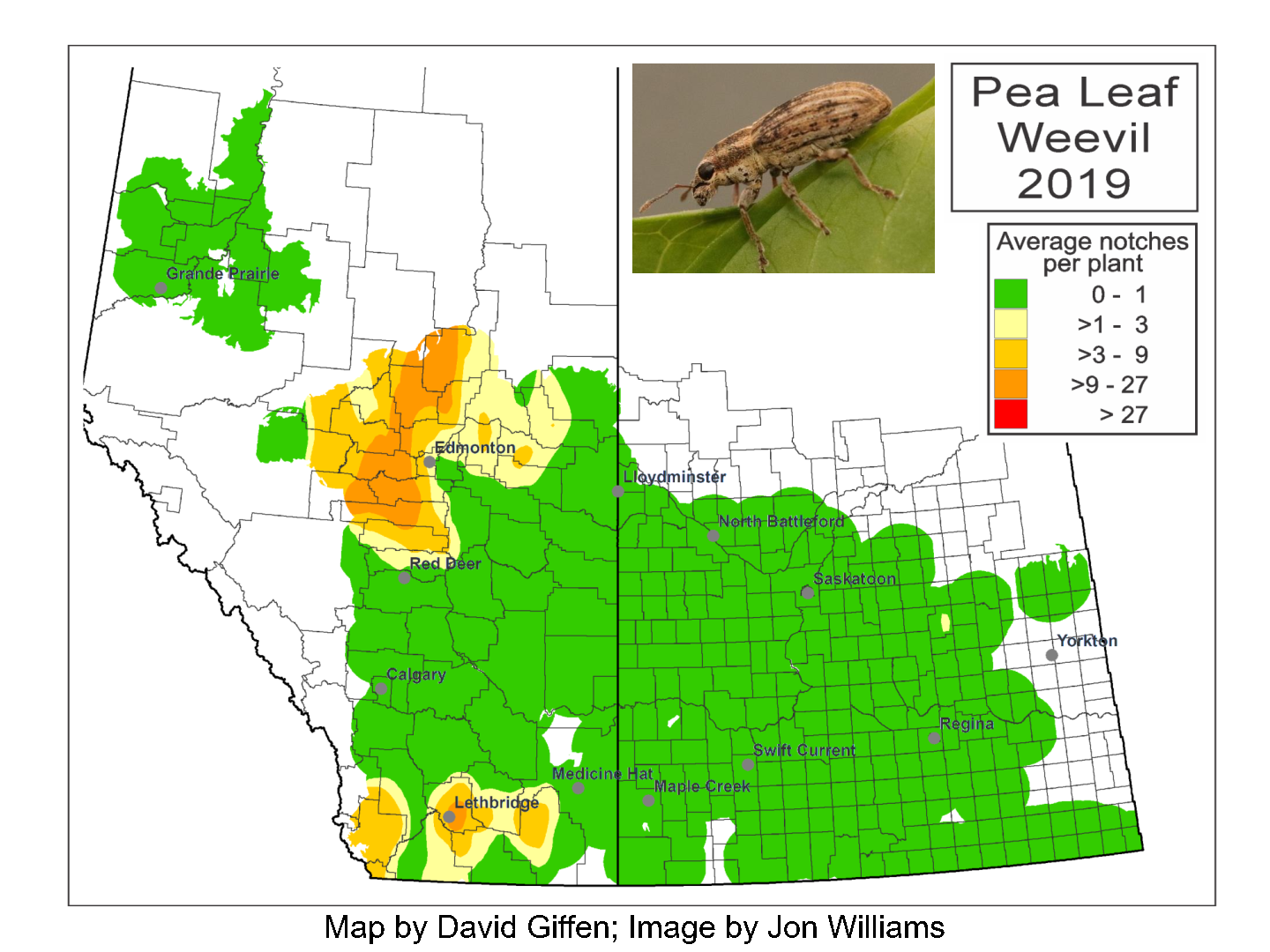
Reminder - The 2019 prairie-wide risk map for pea leaf weevils was released in March 2020.  The map is based on the number of feeding notches observed in peas (Fig. 2). 
Figure 2. Estimates of pea leaf weevil (S. lineatus) densities based on feeding notches observed in
peas grown in Alberta and Saskatchewan in 2019.

Biological and monitoring information related to pea leaf weevil in field crops is posted by the province of Alberta and in the PPMN monitoring protocol.

Also refer to the pea leaf weevil page within the "Field Crop and Forage Pests and their Natural Enemies in Western Canada: Identification and management field guide" - both English-enhanced or French-enhanced versions are available. 

Friday, 22 May 2020

Flea beetles

Flea Beetles (Chrysomelidae: Phyllotreta species) – The Action Threshold for flea beetles on canola is 25% of cotyledon leaf area consumed.  Watch for "shot-hole" feeding in seedling canola but also watch the growing point and stems of seedlings which are particularly vulnerable to flea beetle feeding.  Link here to review photos and scouting tips for flea beetles in canola (Wk03).
Figure 1.  Flea beetle feeding on leaves canola seedling resulting in "shot-hole" damage plus girdling of stem (left) plus dorsal view of striped flea beetle (right).

Scouting Charts - Canola and Flax

Click here to access TWO generalized insect pest scouting charts (with hyperlinks to the insect guide) intended to aid in-field scouting on the Canadian prairies.

Friday, 15 May 2020

Flea beetles

Flea Beetles (Chrysomelidae: Phyllotreta species) – Check the latest Canola Watch May 13, 2020 article describing flea beetles feeding on volunteers which also links to management tips for flea beetles in canola. 

As canola seedlings emerge, scout for flea beetle damage on cotyledons but also on the stem (Fig. 1, left).  Two species, Phyllotreta striolata (Fig. 1, right) and P. cruciferae, will feed on all cruciferous plants but they can cause economic levels of damage in canola seedlings.  


Figure 1.  Flea beetle feeding on leaves canola seedling resulting in "shot-hole" damage plus girdling of stem (left) plus dorsal view of striped flea beetle (right).

Remember, the Action Threshold for flea beetles on canola is 25% of cotyledon leaf area consumed.  Watch for "shot-hole" feeding in seedling canola but also watch the growing point and stems of seedlings which are particularly vulnerable to flea beetle feeding.


Estimating flea beetle feeding damage can be challenging.  Using a visual guide to estimate damage can be helpful.  Canola Watch circulated this article but also use the two images (copied below for reference) produced by Dr. J. Soroka (AAFC-Saskatoon)  - take it scouting!
Figure 1. Canola cotyledons with various percentages of leaf area consume owing to 
flea beetle feeding damage (Photo: Soroka & Underwood, AAFC-Saskatoon).

Figure 2.  Percent leaf area consumed by flea beetles feeding on canola seedlings 
(Photo: Soroka & Underwood, AAFC-Saskatoon).

Refer to the flea beetle page within the "Field Crop and Forage Pests and their Natural Enemies in Western Canada: Identification and management field guide" (Philip et al. 2018) as an English-enhanced or French-enhanced version.

Scouting Charts - Canola and Flax

Click here to access TWO generalized insect pest scouting charts (with hyperlinks to the insect guide) intended to aid in-field scouting on the Canadian prairies.

Friday, 8 May 2020

Flea beetles

Flea Beetles (Chrysomelidae: Phyllotreta species) – As canola seedlings emerge, scout for flea beetle damage on cotyledons but also on the stem (Fig. 1, left).  Two species, Phyllotreta striolata (Fig. 1, right) and P. cruciferae, will feed on all cruciferous plants but they can cause economic levels of damage in canola seedlings.


Figure 1.  Flea beetle feeding on leaves canola seedling resulting in "shot-hole" damage plus girdling of stem (left) plus dorsal view of striped flea beetle (right).

Remember, the Action Threshold for flea beetles on canola is 25% of cotyledon leaf area consumed.  Watch for "shot-hole" feeding in seedling canola but also watch the growing point and stems of seedlings which are particularly vulnerable to flea beetle feeding.


Estimating flea beetle feeding damage can be challenging.  Using a visual guide to estimate damage can be helpful.  Canola Watch circulated this article but also use the two images (copied below for reference) produced by Dr. J. Soroka (AAFC-Saskatoon)  - take it scouting!
Figure 1. Canola cotyledons with various percentages of leaf area consume owing to 
flea beetle feeding damage (Photo: Soroka & Underwood, AAFC-Saskatoon).

Figure 2.  Percent leaf area consumed by flea beetles feeding on canola seedlings 
(Photo: Soroka & Underwood, AAFC-Saskatoon).

Refer to the flea beetle page within the "Field Crop and Forage Pests and their Natural Enemies in Western Canada: Identification and management field guide" (Philip et al. 2018) as an English-enhanced or French-enhanced version.

Scouting Charts - Canola and Flax

Reminder - Field scouting is critical - it enables the identification of potential risks to crops. Accurate identification of insect pests PLUS the application of established monitoring methods will enable growers to make informed pest management decisions.

We offer TWO generalized insect pest scouting charts (with hyperlinks) to aid in-field scouting on the Canadian prairies:

1. CANOLA INSECT SCOUTING CHART


2. FLAX INSECT SCOUTING CHART


These charts feature hyperlinks directing growers to downloadable PDF pages within the "Field crop and forage pests and their natural enemies in western Canada: Identification and management field guide".

Whenever possible, monitor and compare pest densities to established economic or action thresholds to protect and preserve pollinators and beneficial arthropods. Economic thresholds, by definition, help growers avoid crop losses related to outbreaking insect pest species.

Good luck with scouting!

Thursday, 30 April 2020

Scouting Charts - Canola and Flax

Field scouting is critical - it enables the identification of potential risks to crops. Accurate identification of insect pests PLUS the application of established monitoring methods will enable growers to make informed pest management decisions.

We offer TWO generalized insect pest scouting charts to aid in-field scouting on the Canadian prairies:

1. CANOLA INSECT SCOUTING CHART


2. FLAX INSECT SCOUTING CHART


These charts feature hyperlinks directing growers to downloadable PDF pages within the "Field crop and forage pests and their natural enemies in western Canada: Identification and management field guide".

Whenever possible, monitor and compare pest densities to established economic or action thresholds to protect and preserve pollinators and beneficial arthropods. Economic thresholds, by definition, help growers avoid crop losses related to outbreaking insect pest species.

Good luck with your scouting!

Friday, 2 August 2019

Scouting Charts - Canola and Flax (August 1, 2019; Wk 17)

Reminder - One last time for this growing season..... We have updated the field scouting charts so they now link to pages within the 2018 version of the Insect Field Guide. 

We offer TWO generalized insect pest scouting charts to aid in-field scouting on the Canadian prairies:

1. CANOLA INSECT SCOUTING CHART


2. FLAX INSECT SCOUTING CHART


These charts feature hyperlinks directing growers to downloadable PDF pages within the "Field crop and forage pests and their natural enemies in western Canada: Identification and management field guide".

Whenever possible, monitor and compare pest densities to established economic or action thresholds to protect and preserve pollinators and beneficial arthropods. Economic thresholds, by definition, help growers avoid crop losses related to insect pest species but they rely on in-field scouting!

Friday, 7 June 2019

Pea leaf weevil (June 6, 2019; Wk 09)

Pea Leaf Weevil (Sitona lineatus) – Model runs for Red Deer and Saskatoon were projected to June 30, 2019. Results indicated that oviposition is well underway at both locations.  
Figure 1. Predicted status of pea leaf weevil populations near Red Deer AB projected to June 30, 2019, using long term average temperatures.


Figure 2.  Predicted status of pea leaf weevil populations near Saskatoon SK projected to June 30, 2019, using long term average temperatures.

This week, pea leaf weevil and its doppelgangers were featured as part of the INSECT OF THE WEEK.  

Adults will feed upon the leaf margins and growing points of legume seedlings (alfalfa, clover, dry beans, faba beans, peas) and produce a characteristic, scalloped (notched) edge.  Females lay 1000 to 1500 eggs in the soil either near or on developing pea or faba bean plants from May to June.


Biological and monitoring information related to pea leaf weevil in field crops is posted by the province of Alberta and in the PPMN monitoring protocol.

Also refer to the pea leaf weevil page within the "Field Crop and Forage Pests and their Natural Enemies in Western Canada: Identification and management field guide" - both English-enhanced or French-enhanced versions are available.  A review of this insect was published in 2011 in Prairie Soils and Crops by Carcamo and Vankosky.

Friday, 31 May 2019

Pea leaf weevil (May 30, 2019; Wk 08)

Pea Leaf Weevil (Sitona lineatus) – Model runs for Red Deer AB (Fig. 1) and Swift Current SK (Fig. 2) were projected to June 15, 2019. Results indicated that oviposition should begin early next week. Model predictions, based on long term normal weather data predict that initial hatch near Saskatoon should occur on May 29th.
Figure 1. Projected predicted status of pea leaf weevil populations near Red Deer AB to
June 15, 2019 using long term average temperatures.


Figure 2. Projected predicted status of pea leaf weevil populations near Swift Current SK to
June 15, 2019 using long term average temperatures.

Pea leaf weevils emerge in the spring primarily by flying (at temperatures above 17ÂșC) or they may walk short distances. Pea leaf weevil movement into peas and faba beans is achieved primarily through flight.  Adults are slender, greyish-brown measuring approximately 5 mm in length (Fig. 3, Left).  

The pea leaf weevil resembles the sweet clover weevil (Sitona cylindricollis) but the former is distinguished by three light-coloured stripes extending length-wise down thorax and sometimes the abdomen.  All species of Sitona, including the pea leaf weevil, have a short snout.  


Figure 3.  Comparison images and descriptions of four Sitona species adults including pea leaf weevil (Left).

Adults will feed upon the leaf margins and growing points of legume seedlings (alfalfa, clover, dry beans, faba beans, peas) and produce a characteristic, scalloped (notched) edge.  Females lay 1000 to 1500 eggs in the soil either near or on developing pea or faba bean plants from May to June.


Biological and monitoring information related to pea leaf weevil in field crops is posted by the province of Alberta and in the PPMN monitoring protocol.

Also refer to the pea leaf weevil page within the "Field Crop and Forage Pests and their Natural Enemies in Western Canada: Identification and management field guide" - both English-enhanced or French-enhanced versions are available.  A review of this insect was published in 2011 in Prairie Soils and Crops by Carcamo and Vankosky.

Friday, 24 May 2019

Pea leaf weevil (May 23, 2019; Wk 07)

Pea Leaf Weevil (Sitona lineatus) – Model runs for Red Deer AB (Fig. 1) and Swift Current SK (Fig. 2) were projected to June 15, 2019. Results indicated that oviposition should begin at the end of May. Model predictions, based on long term normal weather data, predict that initial hatch near Saskatoon should occur on May 29th.

Figure 1.  Projected predicted status of pea leaf weevil populations near Red Deer AB to June 15, 2019 using
long term average temperatures.


Figure 2.  Projected predicted status of pea leaf weevil populations near Swift Current SK to June 15, 2019 using
long term average temperatures.

Pea leaf weevils emerge in the spring primarily by flying (at temperatures above 17ÂșC) or they may walk short distances. Pea leaf weevil movement into peas and faba beans is achieved primarily through flight.  Adults are slender, greyish-brown measuring approximately 5 mm in length (Fig. 3, Left).  

The pea leaf weevil resembles the sweet clover weevil (Sitona cylindricollis) but the former is distinguished by three light-coloured stripes extending length-wise down thorax and sometimes the abdomen.  All species of Sitona, including the pea leaf weevil, have a short snout.  


Figure 3.  Comparison images and descriptions of four Sitona species adults including pea leaf weevil (Left).

Adults will feed upon the leaf margins and growing points of legume seedlings (alfalfa, clover, dry beans, faba beans, peas) and produce a characteristic, scalloped (notched) edge.  Females lay 1000 to 1500 eggs in the soil either near or on developing pea or faba bean plants from May to June.


Biological and monitoring information related to pea leaf weevil in field crops is posted by the province of Alberta and in the PPMN monitoring protocol.

Also refer to the pea leaf weevil page within the "Field Crop and Forage Pests and their Natural Enemies in Western Canada: Identification and management field guide" - both English-enhanced or French-enhanced versions are available.  A review of this insect was published in 2011 in Prairie Soils and Crops by Carcamo and Vankosky.

Thursday, 16 May 2019

Flea beetles (May 16, 2019; Wk 06)

Flea Beetles (Chrysomelidae: Phyllotreta species) – As newly seeded stands begin to emerge, the need for in-field scouting increases.  Review Wk05 for flea beetle information, visual guides to help estimate percent of cotyledon damage, and links to the Insect Field Guide.  

This week we also link to Canola Watch which released flea beetle scouting and management tips for canola.  Provincial entomologists, flea beetle researchers and Canola Council of Canada specialists all provided input into this article.


Remember, the Action Threshold for flea beetles on canola is 25% of cotyledon leaf area consumed.  Watch for shot-hole feeding in seedling canola but also watch the growing point and stems of seedlings which are particularly vulnerable to flea beetle feeding.

Pea leaf weevil (May 16, 2019; Wk 06)

Pea Leaf Weevil (Sitona lineatus) – Model runs for Red Deer AB (Fig. 1) and Swift Current SK (Fig. 2) were projected to June 15, 2019. Results indicated that oviposition should begin at the end of May. Model predictions, based on long term normal weather data, predict that initial hatch near Saskatoon should occur on May 29th.

Figure 1.  Projected predicted status of pea leaf weevil populations near Red Deer AB to June 15, 2019 using
long term average temperatures.


Figure 2.  Projected predicted status of pea leaf weevil populations near Swift Current SK to June 15, 2019 using
long term average temperatures.

Pea leaf weevils emerge in the spring primarily by flying (at temperatures above 17ÂșC) or they may walk short distances. Pea leaf weevil movement into peas and faba beans is achieved primarily through flight.  Adults are slender, greyish-brown measuring approximately 5 mm in length (Fig. 3, Left).  

The pea leaf weevil resembles the sweet clover weevil (Sitona cylindricollis) but the former is distinguished by three light-coloured stripes extending length-wise down thorax and sometimes the abdomen.  All species of Sitona, including the pea leaf weevil, have a short snout.  


Figure 3.  Comparison images and descriptions of four Sitona species adults including pea leaf weevil (Left).

Adults will feed upon the leaf margins and growing points of legume seedlings (alfalfa, clover, dry beans, faba beans, peas) and produce a characteristic, scalloped (notched) edge.  Females lay 1000 to 1500 eggs in the soil either near or on developing pea or faba bean plants from May to June.


Biological and monitoring information related to pea leaf weevil in field crops is posted by the province of Alberta and in the PPMN monitoring protocol.

Also refer to the pea leaf weevil page within the "Field Crop and Forage Pests and their Natural Enemies in Western Canada: Identification and management field guide" - both English-enhanced or French-enhanced versions are available.  A review of this insect was published in 2011 in Prairie Soils and Crops by Carcamo and Vankosky.