- Welcome to our new website!
- Weather synopsis
- Predicted wheat midge development
- Predicted grasshopper development
- Bertha armyworm monitoring
- Diamondback moth
- Pea leaf weevil
- Cereal aphid manager
- West nile virus risk
- Scouting charts for canola and flax
- Field heroes
- Provincial insect pest reports
- Crop reports
- Previous posts
- Insect of the Week: Forage grass pests / Dr. Chrystel Olivier
- AND CONGRATULATIONS to the Prairie Crop Disease Monitoring Network on their new Blog!
Showing posts with label Pea leaf weevil. Show all posts
Showing posts with label Pea leaf weevil. Show all posts
Friday, 10 July 2020
Weekly Update links to the NEW website
Click each topic below to access the entire WEEKLY UPDATE (June 9, 2020 for Week 11) over at the NEW WEBSITE!

Friday, 3 July 2020
Pea leaf weevil
Pea Leaf Weevil (Sitona lineatus) – Models runs predicting spring adult activity, oviposition and larval development for this pest are completed as of Week 9 (June 21, 2020). Use the following information to aid in-field scouting for larvae.
The pea leaf weevil is a slender greyish-brown insect measuring approximately 5 mm in length (Fig. 1, Left image). Pea leaf weevil resembles the sweet clover weevil (Sitona cylindricollis) but the former is distinguished by three light-coloured stripes extending length-wise down thorax and sometimes the abdomen. All species of Sitona, including the pea leaf weevil, have a short snout.
Adults will feed upon the leaf margins and growing points of legume seedlings (alfalfa, clover, dry beans, faba beans, peas) and produce a characteristic, scalloped (notched) edge. Females lay 1000 to 1500 eggs in the soil either near or on developing pea or faba bean plants from May to June.
Larvae develop under the soil and are “C” shaped and milky-white with a dark-brown head capsule ranging in length from 3.5-5.5 mm (Figure 2). Larvae develop through five instar stages. After hatching, larvae seek and enter the roots of a pea plant. Larvae will enter and consume the contents of the nodules of the legume host plant. It is the nodules that are responsible for nitrogen-fixation which affect yield plus the plant’s ability to input nitrogen into the soil. Consumption of or damage to the nodules (Figure 3) results in partial or complete inhibition of nitrogen fixation by the plant and results in poor plant growth and low seed yields.
Biological and monitoring information related to pea leaf weevil in field crops is posted by the province of Alberta and in the PPMN monitoring protocol.
The pea leaf weevil is a slender greyish-brown insect measuring approximately 5 mm in length (Fig. 1, Left image). Pea leaf weevil resembles the sweet clover weevil (Sitona cylindricollis) but the former is distinguished by three light-coloured stripes extending length-wise down thorax and sometimes the abdomen. All species of Sitona, including the pea leaf weevil, have a short snout.
 |
| Figure 1. Comparison images and descriptions of four Sitona species adults including pea leaf weevil (Left). |

Adults will feed upon the leaf margins and growing points of legume seedlings (alfalfa, clover, dry beans, faba beans, peas) and produce a characteristic, scalloped (notched) edge. Females lay 1000 to 1500 eggs in the soil either near or on developing pea or faba bean plants from May to June.
Larvae develop under the soil and are “C” shaped and milky-white with a dark-brown head capsule ranging in length from 3.5-5.5 mm (Figure 2). Larvae develop through five instar stages. After hatching, larvae seek and enter the roots of a pea plant. Larvae will enter and consume the contents of the nodules of the legume host plant. It is the nodules that are responsible for nitrogen-fixation which affect yield plus the plant’s ability to input nitrogen into the soil. Consumption of or damage to the nodules (Figure 3) results in partial or complete inhibition of nitrogen fixation by the plant and results in poor plant growth and low seed yields.
 |
| Figure 2. Weevil larva in soil (Photo: L. Dosdall). |
 |
| Figure 3. Pea nodules damaged by larval feeding (Photo: L. Dosdall). |
Biological and monitoring information related to pea leaf weevil in field crops is posted by the province of Alberta and in the PPMN monitoring protocol.
Also refer to the pea leaf weevil page within the "Field Crop and Forage Pests and their Natural Enemies in Western Canada: Identification and management field guide" - both English-enhanced or French-enhanced versions are available.
Thursday, 25 June 2020
Predicted pea leaf weevil development
Pea Leaf Weevil (Sitona lineatus) – As of June 21, 2020, model runs for pea leaf weevil (PLW) indicate that oviposition has peaked at Swift Current and Lacombe. The following two graphs illustrate that larval numbers continue to increase at Swift Current and Lacombe as the eggs continue to hatch.
Pea leaf weevils emerge in the spring primarily by flying (at temperatures above 17 ºC) or they may walk short distances. Pea leaf weevil movement into peas and faba beans is achieved primarily through flight. Adults are slender, greyish-brown measuring approximately 5 mm in length (Fig. 3, Left).
The pea leaf weevil resembles the sweet clover weevil (Sitona cylindricollis) but the former is distinguished by three light-coloured stripes extending length-wise down thorax and sometimes the abdomen. All species of Sitona, including the pea leaf weevil, have a short snout.
Adults will feed upon the leaf margins and growing points of legume seedlings (alfalfa, clover, dry beans, faba beans, peas) and produce a characteristic, scalloped (notched) edge. Females lay 1000 to 1500 eggs in the soil either near or on developing pea or faba bean plants from May to June.
Larvae develop under the soil and are “C” shaped and milky-white with a dark-brown head capsule ranging in length from 3.5-5.5 mm (Figure 4). Larvae develop through five instar stages. After hatching, larvae seek and enter the roots of a pea plant. Larvae will enter and consume the contents of the nodules of the legume host plant. It is the nodules that are responsible for nitrogen-fixation which affect yield plus the plant’s ability to input nitrogen into the soil. Consumption of or damage to the nodules (Figure 5) results in partial or complete inhibition of nitrogen fixation by the plant and results in poor plant growth and low seed yields.
Biological and monitoring information related to pea leaf weevil in field crops is posted by the province of Alberta and in the PPMN monitoring protocol.
 |
| Figure 1. Predicted pea leaf weevil (Sitona lineatus) phenology at Swift Current SK. Values are based on model simulations (April 1-June 21, 2020). |
 |
| Figure 2. Predicted pea leaf weevil (Sitona lineatus) phenology at Lacombe AB. Values are based on model simulations (April 1-June 21, 2020). |
Pea leaf weevils emerge in the spring primarily by flying (at temperatures above 17 ºC) or they may walk short distances. Pea leaf weevil movement into peas and faba beans is achieved primarily through flight. Adults are slender, greyish-brown measuring approximately 5 mm in length (Fig. 3, Left).
The pea leaf weevil resembles the sweet clover weevil (Sitona cylindricollis) but the former is distinguished by three light-coloured stripes extending length-wise down thorax and sometimes the abdomen. All species of Sitona, including the pea leaf weevil, have a short snout.
|
| Figure 3. Comparison images and descriptions of four Sitona species adults including pea leaf weevil (Left). |
Adults will feed upon the leaf margins and growing points of legume seedlings (alfalfa, clover, dry beans, faba beans, peas) and produce a characteristic, scalloped (notched) edge. Females lay 1000 to 1500 eggs in the soil either near or on developing pea or faba bean plants from May to June.
Larvae develop under the soil and are “C” shaped and milky-white with a dark-brown head capsule ranging in length from 3.5-5.5 mm (Figure 4). Larvae develop through five instar stages. After hatching, larvae seek and enter the roots of a pea plant. Larvae will enter and consume the contents of the nodules of the legume host plant. It is the nodules that are responsible for nitrogen-fixation which affect yield plus the plant’s ability to input nitrogen into the soil. Consumption of or damage to the nodules (Figure 5) results in partial or complete inhibition of nitrogen fixation by the plant and results in poor plant growth and low seed yields.
|
| Figure 4. Weevil larva in soil (Photo: L. Dosdall). |
|
| Figure 5. Pea nodules damaged by larval feeding (Photo: L. Dosdall). |
Biological and monitoring information related to pea leaf weevil in field crops is posted by the province of Alberta and in the PPMN monitoring protocol.
Also refer to the pea leaf weevil page within the "Field Crop and Forage Pests and their Natural Enemies in Western Canada: Identification and management field guide" - both English-enhanced or French-enhanced versions are available.
Friday, 19 June 2020
Predicted pea leaf weevil development
Pea Leaf Weevil (Sitona lineatus) – As of June 14, 2020, PLW model runs indicate that PLW females continue to oviposit eggs. The following two graphs illustrate that egg numbers continue to increase at Swift Current (Fig. 1) and Lacombe (Fig. 2). This week, first appearance of PLW larvae is expected to occur at Swift Current (Fig. 1).
Link here to access photos of PLW and related species of weevils which can all be active simultaneously in Canadian prairie field crops.
Biological and monitoring information related to pea leaf weevil in field crops is posted by the province of Alberta and in the PPMN monitoring protocol.
 |
| Figure 1. Predicted pea leaf weevil (Sitona lineatus) phenology at Swift Current SK. Values are based on model simulations (April 1-June 14 2020). |
 |
| Figure 2. Predicted pea leaf weevil (Sitona lineatus) phenology at Lacombe AB. Values are based on model simulations (April 1-June 14 2020). |
Link here to access photos of PLW and related species of weevils which can all be active simultaneously in Canadian prairie field crops.
Biological and monitoring information related to pea leaf weevil in field crops is posted by the province of Alberta and in the PPMN monitoring protocol.
Also refer to the pea leaf weevil page within the "Field Crop and Forage Pests and their Natural Enemies in Western Canada: Identification and management field guide" - both English-enhanced or French-enhanced versions are available.
Friday, 12 June 2020
Predicted pea leaf weevil development
Pea Leaf Weevil (Sitona lineatus) – As of June 7, 2020, the PLW phenology model indicates that females continue to lay eggs. The following two graphs illustrate the pattern of PLW oviposition for Swift Current and Lacombe.
Link here to access photos of PLW and related species of weevils which can all be active simultaneously in Canadian prairie field crops.
Biological and monitoring information related to pea leaf weevil in field crops is posted by the province of Alberta and in the PPMN monitoring protocol.
 |
| Figure 1. Predicted pea leaf weevil (Sitona lineatus) phenology at Swift Current SK. Values are based on model simulations (April 1-June 7, 2020). |
 |
| Figure 1. Predicted pea leaf weevil (Sitona lineatus) phenology at Lacombe AB. Values are based on model simulations (April 1-June 7, 2020). |
Link here to access photos of PLW and related species of weevils which can all be active simultaneously in Canadian prairie field crops.
Biological and monitoring information related to pea leaf weevil in field crops is posted by the province of Alberta and in the PPMN monitoring protocol.
Also refer to the pea leaf weevil page within the "Field Crop and Forage Pests and their Natural Enemies in Western Canada: Identification and management field guide" - both English-enhanced or French-enhanced versions are available.
Thursday, 4 June 2020
Predicted pea leaf weevil development
Pea Leaf Weevil (Sitona lineatus) – The phenology model for pea leaf weevil (PLW) indicates that females recently started to lay eggs (if they are present in those regions). The following two graphs illustrate the pattern of PLW oviposition for Swift Current (Fig. 1) and Lacombe (Fig. 2).
Link here to access photos of PLW and related species of weevils which can all be active simultaneously in Canadian prairie field crops. Also access the 2019 prairie-wide distribution map for this pest at this link.
Biological and monitoring information related to pea leaf weevil in field crops is posted by the province of Alberta and in the PPMN monitoring protocol.
 |
| Figure 1. Predicted pea leaf weevil (Sitona lineatus) phenology at Swift Current SK. Values are based on model simulations (April 1-May 31, 2020). |
 |
| Figure 2. Predicted pea leaf weevil (Sitona lineatus) phenology at Lacombe AB. Values are based on model simulations (April 1-May 31, 2020). |
Link here to access photos of PLW and related species of weevils which can all be active simultaneously in Canadian prairie field crops. Also access the 2019 prairie-wide distribution map for this pest at this link.
Biological and monitoring information related to pea leaf weevil in field crops is posted by the province of Alberta and in the PPMN monitoring protocol.
Also refer to the pea leaf weevil page within the "Field Crop and Forage Pests and their Natural Enemies in Western Canada: Identification and management field guide" - both English-enhanced or French-enhanced versions are available.
Thursday, 28 May 2020
Pea leaf weevil
Pea Leaf Weevil (Sitona lineatus) – Pea leaf weevils emerge in the spring primarily by flying (at temperatures above 17 ºC) or they may walk short distances. Pea leaf weevil movement into peas and faba beans is achieved primarily through flight. Adults are slender, greyish-brown measuring approximately 5 mm in length (Fig. 1, Left).
The pea leaf weevil resembles the sweet clover weevil (Sitona cylindricollis) but the former is distinguished by three light-coloured stripes extending length-wise down thorax and sometimes the abdomen. All species of Sitona, including the pea leaf weevil, have a short snout.
Adults will feed upon the leaf margins and growing points of legume seedlings (alfalfa, clover, dry beans, faba beans, peas) and produce a characteristic, scalloped (notched) edge. Females lay 1000 to 1500 eggs in the soil either near or on developing pea or faba bean plants from May to June.
Reminder - The 2019 prairie-wide risk map for pea leaf weevils was released in March 2020. The map is based on the number of feeding notches observed in peas (Fig. 2).
Biological and monitoring information related to pea leaf weevil in field crops is posted by the province of Alberta and in the PPMN monitoring protocol.
The pea leaf weevil resembles the sweet clover weevil (Sitona cylindricollis) but the former is distinguished by three light-coloured stripes extending length-wise down thorax and sometimes the abdomen. All species of Sitona, including the pea leaf weevil, have a short snout.
|
| Figure 1. Comparison images and descriptions of four Sitona species adults including pea leaf weevil (Left). |
Adults will feed upon the leaf margins and growing points of legume seedlings (alfalfa, clover, dry beans, faba beans, peas) and produce a characteristic, scalloped (notched) edge. Females lay 1000 to 1500 eggs in the soil either near or on developing pea or faba bean plants from May to June.
Reminder - The 2019 prairie-wide risk map for pea leaf weevils was released in March 2020. The map is based on the number of feeding notches observed in peas (Fig. 2).
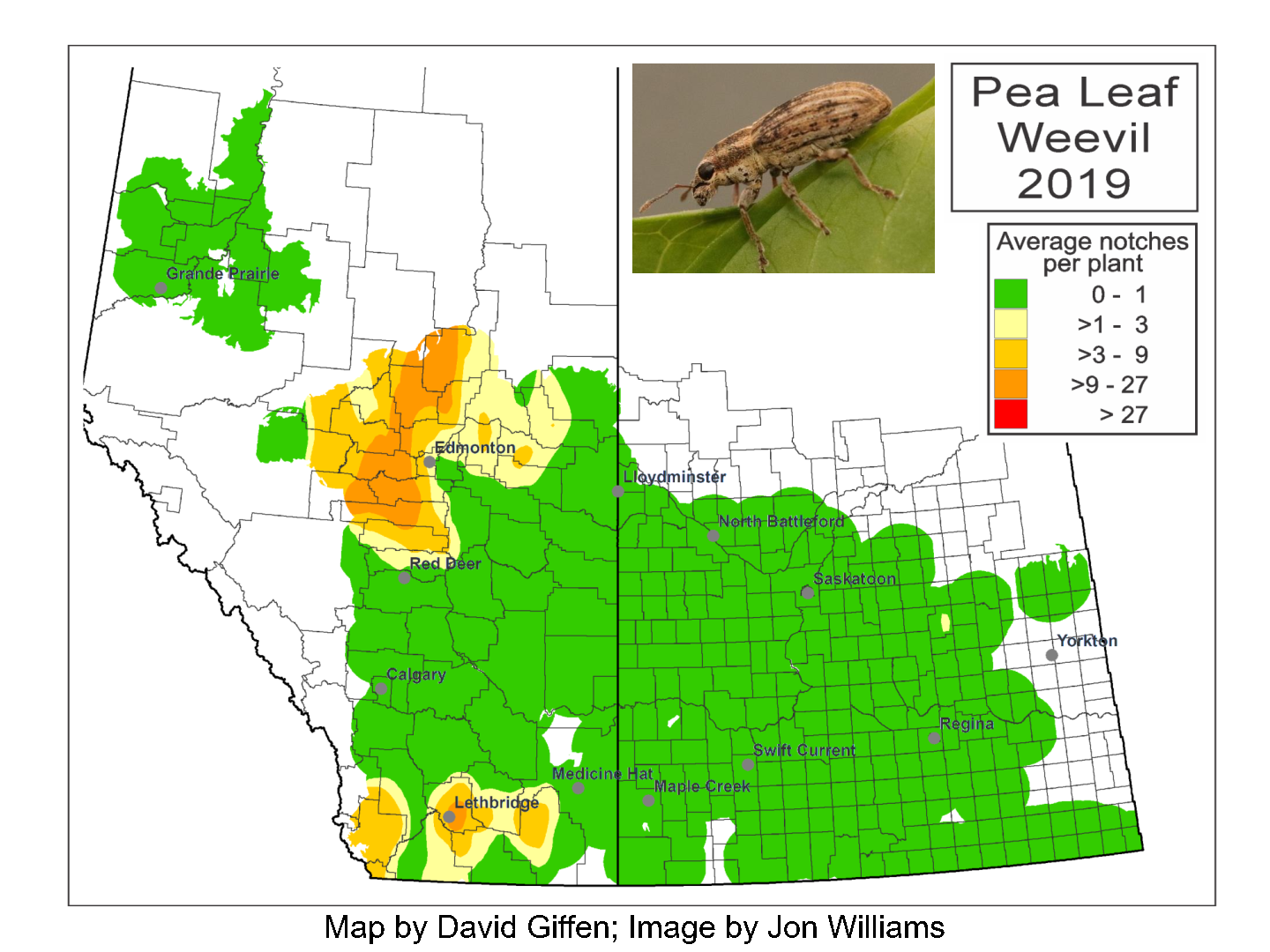 |
| Figure 2. Estimates of pea leaf weevil (S. lineatus) densities based on feeding notches observed in peas grown in Alberta and Saskatchewan in 2019. |
Biological and monitoring information related to pea leaf weevil in field crops is posted by the province of Alberta and in the PPMN monitoring protocol.
Also refer to the pea leaf weevil page within the "Field Crop and Forage Pests and their Natural Enemies in Western Canada: Identification and management field guide" - both English-enhanced or French-enhanced versions are available.
Friday, 14 June 2019
Recap of earlier predicted model outputs (June 13, 2019; Wk 10)
Last week, predictive model outputs were projected into June. Please review the information for these insect pests by clicking the hyperlink:
● Pea leaf weevil - projected to June 30th
● Cereal leaf beetle - projected to June 21st
● Pea leaf weevil - projected to June 30th
● Cereal leaf beetle - projected to June 21st
Friday, 7 June 2019
Pea leaf weevil (June 6, 2019; Wk 09)
Pea Leaf Weevil (Sitona lineatus) – Model runs for Red Deer and Saskatoon were projected to June 30, 2019. Results indicated that oviposition is well underway at both locations.
This week, pea leaf weevil and its doppelgangers were featured as part of the INSECT OF THE WEEK.
Adults will feed upon the leaf margins and growing points of legume seedlings (alfalfa, clover, dry beans, faba beans, peas) and produce a characteristic, scalloped (notched) edge. Females lay 1000 to 1500 eggs in the soil either near or on developing pea or faba bean plants from May to June.
Biological and monitoring information related to pea leaf weevil in field crops is posted by the province of Alberta and in the PPMN monitoring protocol.
Also refer to the pea leaf weevil page within the "Field Crop and Forage Pests and their Natural Enemies in Western Canada: Identification and management field guide" - both English-enhanced or French-enhanced versions are available. A review of this insect was published in 2011 in Prairie Soils and Crops by Carcamo and Vankosky.
 |
| Figure 1. Predicted status of pea leaf weevil populations near Red Deer AB projected to June 30, 2019, using long term average temperatures. |
 |
| Figure 2. Predicted status of pea leaf weevil populations near Saskatoon SK projected to June 30, 2019, using long term average temperatures. |
This week, pea leaf weevil and its doppelgangers were featured as part of the INSECT OF THE WEEK.
Adults will feed upon the leaf margins and growing points of legume seedlings (alfalfa, clover, dry beans, faba beans, peas) and produce a characteristic, scalloped (notched) edge. Females lay 1000 to 1500 eggs in the soil either near or on developing pea or faba bean plants from May to June.
Also refer to the pea leaf weevil page within the "Field Crop and Forage Pests and their Natural Enemies in Western Canada: Identification and management field guide" - both English-enhanced or French-enhanced versions are available. A review of this insect was published in 2011 in Prairie Soils and Crops by Carcamo and Vankosky.
Monday, 3 June 2019
Insect of the Week (June 3, 2019) - Doppelgangers: Pea leaf weevil and other Sitona species
The case of the innocuous versus the evil
twin: When making pest management decisions, be sure that the suspect is a actually a pest. This can be
challenge since insects often mimic each other or look
very similar. An insect that looks, moves and acts like a pest may in fact be a
look-alike or doppelganger.
Doppelgangers may be related (e.g. same genus) or may not be related, as in the case monarch butterflies (Danaus plexippus) and viceroys (Limenitis achrippus). In some cases, doppelgangers are relatively harmless. In others, the doppelganger is a pest too yet behaviour, lifecycle and hosts may be different.
Correctly identifying a pest enables selection of the most accurate scouting or monitoring protocol. Identification and monitoring enables the application of economic thresholds. It also enables a producer to select and apply the most effective control option(s) including method and timing of application. For the rest of the growing season, the Insect of the Week will feature insect crop pests and their doppelgangers.
The case of the pea weevil and other Sitona species doppelgangers
Weevils of the genus Sitona are broad-nosed weevils that are pests of various legume crops, including field pea, faba bean, alfalfa and sweet clover. Sitona larvae attack the roots of the host plant and usually consume the root nodules and the enclosed symbiotic bacteria that fix nitrogen. Adult Sitona weevils consume plant leaves resulting in ‘U’-shaped feeding notches. Sitona species known to occur in Canada include:
• Sitona lineatus – pea leaf weevil (Fig. 1), has two primary hosts: field pea and faba bean.
• Sitona cylindricollis – clover root weevil or sweet clover weevil (Fig. 4).
• Sitona hispidulus – clover root curculio* (Fig. 3), a clover pest.
• Sitona lineellus – alfalfa curculio (Fig. 5), eats alfalfa, vetch and field pea.
• Sitona obsoletus (=S. flavescens = S. lepidus) – clover root curculio*, a clover pest (Fig. 6).
* Note that common names can be used to describe more than one species and can be confusing.
Doppelgangers may be related (e.g. same genus) or may not be related, as in the case monarch butterflies (Danaus plexippus) and viceroys (Limenitis achrippus). In some cases, doppelgangers are relatively harmless. In others, the doppelganger is a pest too yet behaviour, lifecycle and hosts may be different.
Correctly identifying a pest enables selection of the most accurate scouting or monitoring protocol. Identification and monitoring enables the application of economic thresholds. It also enables a producer to select and apply the most effective control option(s) including method and timing of application. For the rest of the growing season, the Insect of the Week will feature insect crop pests and their doppelgangers.
The case of the pea weevil and other Sitona species doppelgangers
Weevils of the genus Sitona are broad-nosed weevils that are pests of various legume crops, including field pea, faba bean, alfalfa and sweet clover. Sitona larvae attack the roots of the host plant and usually consume the root nodules and the enclosed symbiotic bacteria that fix nitrogen. Adult Sitona weevils consume plant leaves resulting in ‘U’-shaped feeding notches. Sitona species known to occur in Canada include:
• Sitona lineatus – pea leaf weevil (Fig. 1), has two primary hosts: field pea and faba bean.
• Sitona cylindricollis – clover root weevil or sweet clover weevil (Fig. 4).
• Sitona hispidulus – clover root curculio* (Fig. 3), a clover pest.
• Sitona lineellus – alfalfa curculio (Fig. 5), eats alfalfa, vetch and field pea.
• Sitona obsoletus (=S. flavescens = S. lepidus) – clover root curculio*, a clover pest (Fig. 6).
* Note that common names can be used to describe more than one species and can be confusing.
 |
| Figure 1. Pea leaf weevil (Sitona lineatus L.). Photo: AAFC-Sasktoon-Williams. |
The above five Sitona species found in Canada are doppelgangers of each other for several reasons:
1. Similar in size and appearance - Require a taxonomic key and microscope to accurately identify to species. Notable difference is Sitona hispidulus which has hairy elytra compared to the other four species which lack hair on their elytra (Fig. 2).
2. Sitona weevils share primary and secondary hosts - Pea leaf weevils must feed on primary hosts (i.e., field pea and faba bean) to attain sexual maturation AND the larvae must feed on primary hosts to successfully develop. However, early in the spring and again in the fall, pea leaf weevils feed on virtually any species of legume, including the primary host plants of the other four Sitona species.
3. Foliar feeding damage is similar - According to Weich and Clements (1992), “careful scrutiny” is required to differentiate the feeding damage caused by different Sitona species feeding on the same host plant. Therefore, it is important to collect adult weevils for identification to confirm which species is responsible for foliar damage.
 |
| Figure 2. Characteristics of four of the five Sitona species found in Canada, useful when scouting for pea leaf weevils. See also the pea leaf weevil monitoring protocol. Images © AAFC-Beaverlodge |
Species pages for all five species
available by searching the species names in the E.H. Strickland Entomology
Museum: http://www.entomology.museums.ualberta.ca/searching.php
 |
| Figure 3. Clover root curculio (Sitona hispicula Fabricious). Photo: © Donald Hobern |
 |
| Figure 4. Sweet clover weevil (Sitona cylindricollis Fahreaus). Photo: © Janet Graham. |
 |
| Figure 5. Alfalfa curculio (Sitona lineellus Bonsdorff). Photo: © by nc Chris Moody. |
 |
| Figure 6. Clover root curculio (Sitona obsoletus). Photo: by K. Walker |
More information about pea leaf weevil (Sitona lineatus), and sweetclover weevil (Sitona cylindricollis) can be accessed on the Insect of
the Week page. Information
related to crop pests and their natural enemies can be found in the newly
updated Field Guide and Cutworm
Guide. Both are available for free download on
our Insect
Field Guide and Cutworm
Field Guide pages.
Friday, 31 May 2019
Pea leaf weevil (May 30, 2019; Wk 08)
Pea Leaf Weevil (Sitona lineatus) – Model runs for Red Deer AB (Fig. 1) and Swift Current SK (Fig. 2) were projected to June 15, 2019. Results indicated that oviposition should begin early next week. Model predictions, based on long term normal weather data predict that initial hatch near Saskatoon should occur on May 29th.
Pea leaf weevils emerge in the spring primarily by flying (at temperatures above 17ºC) or they may walk short distances. Pea leaf weevil movement into peas and faba beans is achieved primarily through flight. Adults are slender, greyish-brown measuring approximately 5 mm in length (Fig. 3, Left).
The pea leaf weevil resembles the sweet clover weevil (Sitona cylindricollis) but the former is distinguished by three light-coloured stripes extending length-wise down thorax and sometimes the abdomen. All species of Sitona, including the pea leaf weevil, have a short snout.
Adults will feed upon the leaf margins and growing points of legume seedlings (alfalfa, clover, dry beans, faba beans, peas) and produce a characteristic, scalloped (notched) edge. Females lay 1000 to 1500 eggs in the soil either near or on developing pea or faba bean plants from May to June.
Biological and monitoring information related to pea leaf weevil in field crops is posted by the province of Alberta and in the PPMN monitoring protocol.
Also refer to the pea leaf weevil page within the "Field Crop and Forage Pests and their Natural Enemies in Western Canada: Identification and management field guide" - both English-enhanced or French-enhanced versions are available. A review of this insect was published in 2011 in Prairie Soils and Crops by Carcamo and Vankosky.
 |
| Figure 1. Projected predicted status of pea leaf weevil populations near Red Deer AB to June 15, 2019 using long term average temperatures. |
 |
| Figure 2. Projected predicted status of pea leaf weevil populations near Swift Current SK to June 15, 2019 using long term average temperatures. |
Pea leaf weevils emerge in the spring primarily by flying (at temperatures above 17ºC) or they may walk short distances. Pea leaf weevil movement into peas and faba beans is achieved primarily through flight. Adults are slender, greyish-brown measuring approximately 5 mm in length (Fig. 3, Left).
The pea leaf weevil resembles the sweet clover weevil (Sitona cylindricollis) but the former is distinguished by three light-coloured stripes extending length-wise down thorax and sometimes the abdomen. All species of Sitona, including the pea leaf weevil, have a short snout.
|
| Figure 3. Comparison images and descriptions of four Sitona species adults including pea leaf weevil (Left). |
Adults will feed upon the leaf margins and growing points of legume seedlings (alfalfa, clover, dry beans, faba beans, peas) and produce a characteristic, scalloped (notched) edge. Females lay 1000 to 1500 eggs in the soil either near or on developing pea or faba bean plants from May to June.
Also refer to the pea leaf weevil page within the "Field Crop and Forage Pests and their Natural Enemies in Western Canada: Identification and management field guide" - both English-enhanced or French-enhanced versions are available. A review of this insect was published in 2011 in Prairie Soils and Crops by Carcamo and Vankosky.
Friday, 24 May 2019
Pea leaf weevil (May 23, 2019; Wk 07)
Pea Leaf Weevil (Sitona lineatus) – Model runs for Red Deer AB (Fig. 1) and Swift Current SK (Fig. 2) were projected to June 15, 2019. Results indicated that oviposition should begin at the end of May. Model predictions, based on long term normal weather data, predict that initial hatch near Saskatoon should occur on May 29th.
Pea leaf weevils emerge in the spring primarily by flying (at temperatures above 17ºC) or they may walk short distances. Pea leaf weevil movement into peas and faba beans is achieved primarily through flight. Adults are slender, greyish-brown measuring approximately 5 mm in length (Fig. 3, Left).
The pea leaf weevil resembles the sweet clover weevil (Sitona cylindricollis) but the former is distinguished by three light-coloured stripes extending length-wise down thorax and sometimes the abdomen. All species of Sitona, including the pea leaf weevil, have a short snout.
Adults will feed upon the leaf margins and growing points of legume seedlings (alfalfa, clover, dry beans, faba beans, peas) and produce a characteristic, scalloped (notched) edge. Females lay 1000 to 1500 eggs in the soil either near or on developing pea or faba bean plants from May to June.
Biological and monitoring information related to pea leaf weevil in field crops is posted by the province of Alberta and in the PPMN monitoring protocol.
Also refer to the pea leaf weevil page within the "Field Crop and Forage Pests and their Natural Enemies in Western Canada: Identification and management field guide" - both English-enhanced or French-enhanced versions are available. A review of this insect was published in 2011 in Prairie Soils and Crops by Carcamo and Vankosky.
 |
Figure 1. Projected predicted status of pea leaf weevil populations near Red Deer AB to June 15, 2019 using long term average temperatures. |
 |
Figure 2. Projected predicted status of pea leaf weevil populations near Swift Current SK to June 15, 2019 using long term average temperatures. |
Pea leaf weevils emerge in the spring primarily by flying (at temperatures above 17ºC) or they may walk short distances. Pea leaf weevil movement into peas and faba beans is achieved primarily through flight. Adults are slender, greyish-brown measuring approximately 5 mm in length (Fig. 3, Left).
The pea leaf weevil resembles the sweet clover weevil (Sitona cylindricollis) but the former is distinguished by three light-coloured stripes extending length-wise down thorax and sometimes the abdomen. All species of Sitona, including the pea leaf weevil, have a short snout.
|
| Figure 3. Comparison images and descriptions of four Sitona species adults including pea leaf weevil (Left). |
Adults will feed upon the leaf margins and growing points of legume seedlings (alfalfa, clover, dry beans, faba beans, peas) and produce a characteristic, scalloped (notched) edge. Females lay 1000 to 1500 eggs in the soil either near or on developing pea or faba bean plants from May to June.
Also refer to the pea leaf weevil page within the "Field Crop and Forage Pests and their Natural Enemies in Western Canada: Identification and management field guide" - both English-enhanced or French-enhanced versions are available. A review of this insect was published in 2011 in Prairie Soils and Crops by Carcamo and Vankosky.
Thursday, 16 May 2019
Pea leaf weevil (May 16, 2019; Wk 06)
Pea Leaf Weevil (Sitona lineatus) – Model runs for Red Deer AB (Fig. 1) and Swift Current SK (Fig. 2) were projected to June 15, 2019. Results indicated that oviposition should begin at the end of May. Model predictions, based on long term normal weather data, predict that initial hatch near Saskatoon should occur on May 29th.
Pea leaf weevils emerge in the spring primarily by flying (at temperatures above 17ºC) or they may walk short distances. Pea leaf weevil movement into peas and faba beans is achieved primarily through flight. Adults are slender, greyish-brown measuring approximately 5 mm in length (Fig. 3, Left).
The pea leaf weevil resembles the sweet clover weevil (Sitona cylindricollis) but the former is distinguished by three light-coloured stripes extending length-wise down thorax and sometimes the abdomen. All species of Sitona, including the pea leaf weevil, have a short snout.
Adults will feed upon the leaf margins and growing points of legume seedlings (alfalfa, clover, dry beans, faba beans, peas) and produce a characteristic, scalloped (notched) edge. Females lay 1000 to 1500 eggs in the soil either near or on developing pea or faba bean plants from May to June.
Biological and monitoring information related to pea leaf weevil in field crops is posted by the province of Alberta and in the PPMN monitoring protocol.
Also refer to the pea leaf weevil page within the "Field Crop and Forage Pests and their Natural Enemies in Western Canada: Identification and management field guide" - both English-enhanced or French-enhanced versions are available. A review of this insect was published in 2011 in Prairie Soils and Crops by Carcamo and Vankosky.
|
Figure 1. Projected predicted status of pea leaf weevil populations near Red Deer AB to June 15, 2019 using long term average temperatures. |
|
Figure 2. Projected predicted status of pea leaf weevil populations near Swift Current SK to June 15, 2019 using long term average temperatures. |
Pea leaf weevils emerge in the spring primarily by flying (at temperatures above 17ºC) or they may walk short distances. Pea leaf weevil movement into peas and faba beans is achieved primarily through flight. Adults are slender, greyish-brown measuring approximately 5 mm in length (Fig. 3, Left).
The pea leaf weevil resembles the sweet clover weevil (Sitona cylindricollis) but the former is distinguished by three light-coloured stripes extending length-wise down thorax and sometimes the abdomen. All species of Sitona, including the pea leaf weevil, have a short snout.
|
| Figure 3. Comparison images and descriptions of four Sitona species adults including pea leaf weevil (Left). |
Adults will feed upon the leaf margins and growing points of legume seedlings (alfalfa, clover, dry beans, faba beans, peas) and produce a characteristic, scalloped (notched) edge. Females lay 1000 to 1500 eggs in the soil either near or on developing pea or faba bean plants from May to June.
Also refer to the pea leaf weevil page within the "Field Crop and Forage Pests and their Natural Enemies in Western Canada: Identification and management field guide" - both English-enhanced or French-enhanced versions are available. A review of this insect was published in 2011 in Prairie Soils and Crops by Carcamo and Vankosky.
Thursday, 9 May 2019
Pea leaf weevil (May 9, 2019; Wk 05)
Pea Leaf Weevil (Sitona lineatus) – The PLW model was run for Red Deer AB (Fig. 1) and Saskatoon SK (Fig. 2). The predictive model outputs suggest that PLW adults are active but oviposition has not begun.
Pea leaf weevils emerge in the spring primarily by flying (at temperatures above 17ºC) or they may walk short distances. Pea leaf weevil movement into peas and faba beans is achieved primarily through flight. Adults are slender, greyish-brown measuring approximately 5 mm in length (Fig. 3, Left).
The pea leaf weevil resembles the sweet clover weevil (Sitona cylindricollis) but the former is distinguished by three light-coloured stripes extending length-wise down thorax and sometimes the abdomen. All species of Sitona, including the pea leaf weevil, have a short snout.
Adults will feed upon the leaf margins and growing points of legume seedlings (alfalfa, clover, dry beans, faba beans, peas) and produce a characteristic, scalloped (notched) edge. Females lay 1000 to 1500 eggs in the soil either near or on developing pea or faba bean plants from May to June.
Biological and monitoring information related to pea leaf weevil in field crops is posted by the province of Alberta and in the PPMN monitoring protocol.
Also refer to the pea leaf weevil page within the "Field Crop and Forage Pests and their Natural Enemies in Western Canada: Identification and management field guide" - both English-enhanced or French-enhanced versions are available. A review of this insect was published in 2011 in Prairie Soils and Crops by Carcamo and Vankosky.
 |
Figure 1. Predicted status of pea leaf weevil populations near Red Deer as of May 7, 2019. |
 |
Figure 2. Predicted status of pea leaf weevil populations near Saskatoon SK as of May 7, 2019. |
The pea leaf weevil resembles the sweet clover weevil (Sitona cylindricollis) but the former is distinguished by three light-coloured stripes extending length-wise down thorax and sometimes the abdomen. All species of Sitona, including the pea leaf weevil, have a short snout.
|
| Figure 3. Comparison images and descriptions of four Sitona species adults including pea leaf weevil (Left). |
Adults will feed upon the leaf margins and growing points of legume seedlings (alfalfa, clover, dry beans, faba beans, peas) and produce a characteristic, scalloped (notched) edge. Females lay 1000 to 1500 eggs in the soil either near or on developing pea or faba bean plants from May to June.
Also refer to the pea leaf weevil page within the "Field Crop and Forage Pests and their Natural Enemies in Western Canada: Identification and management field guide" - both English-enhanced or French-enhanced versions are available. A review of this insect was published in 2011 in Prairie Soils and Crops by Carcamo and Vankosky.
Thursday, 2 May 2019
Pea leaf weevil (May 2, 2019; Wk 04)
Pea Leaf Weevil (Sitona lineatus) – The PLW model was run for Red Deer AB (Fig. 1) and Saskatoon SK (Fig. 2). The output suggests that PLW are beginning to become active and will begin to fly on warmer days (Figs. 1 and 2).
Pea leaf weevils emerge in the spring primarily by flying (at temperatures above 17ºC) or they may walk short distances. Pea leaf weevil movement into peas and faba beans is achieved primarily through flight. Adults are slender, greyish-brown measuring approximately 5 mm in length (Fig. 3, Left).
The pea leaf weevil resembles the sweet clover weevil (Sitona cylindricollis) but the former is distinguished by three light-coloured stripes extending length-wise down thorax and sometimes the abdomen. All species of Sitona, including the pea leaf weevil, have a short snout.
Adults will feed upon the leaf margins and growing points of legume seedlings (alfalfa, clover, dry beans, faba beans, peas) and produce a characteristic, scalloped (notched) edge. Females lay 1000 to 1500 eggs in the soil either near or on developing pea or faba bean plants from May to June.
Biological and monitoring information related to pea leaf weevil in field crops is posted by the province of Alberta and in the PPMN monitoring protocol.
Also refer to the pea leaf weevil page within the "Field Crop and Forage Pests and their Natural Enemies in Western Canada: Identification and management field guide" - both English-enhanced or French-enhanced versions are available. A review of this insect was published in 2011 in Prairie Soils and Crops by Carcamo and Vankosky.
 |
Figure 1. Predicted overwintered PLW adults near Red Deer AB as of April 30, 2019. |
 |
| Figure 2. Predicted overwintered PLW adults near Saskatoon SK as of April 30, 2019. |
Pea leaf weevils emerge in the spring primarily by flying (at temperatures above 17ºC) or they may walk short distances. Pea leaf weevil movement into peas and faba beans is achieved primarily through flight. Adults are slender, greyish-brown measuring approximately 5 mm in length (Fig. 3, Left).
The pea leaf weevil resembles the sweet clover weevil (Sitona cylindricollis) but the former is distinguished by three light-coloured stripes extending length-wise down thorax and sometimes the abdomen. All species of Sitona, including the pea leaf weevil, have a short snout.
|
| Figure 3. Comparison images and descriptions of four Sitona species adults including pea leaf weevil (Left). |
Adults will feed upon the leaf margins and growing points of legume seedlings (alfalfa, clover, dry beans, faba beans, peas) and produce a characteristic, scalloped (notched) edge. Females lay 1000 to 1500 eggs in the soil either near or on developing pea or faba bean plants from May to June.
Also refer to the pea leaf weevil page within the "Field Crop and Forage Pests and their Natural Enemies in Western Canada: Identification and management field guide" - both English-enhanced or French-enhanced versions are available. A review of this insect was published in 2011 in Prairie Soils and Crops by Carcamo and Vankosky.
Subscribe to:
Posts (Atom)