Showing posts with label Canola flower midge. Show all posts

Monday, 23 July 2018

Insect of the Week (July 23, 2018) - Natural enemies of the canola flower midge


This week’s Insects of the Week are two parasitoid wasps, an Inostemma sp. (Hymenoptera: Platygastridae) and a Gastrancistus sp. (Hymenoptera: Pteromalidae). These parasitoids are natural enemies of the canola flower midge (Contarinia sp., Diptera: Cecidomyiidae), a newly discovered fly species that uses canola as its host plant. The parasitoids have been found throughout the Prairies emerging from infested galls created by the canola flower midge. Little is known about these two species, but parasitism rates as high as 30% have been noted in northeast Saskatchewan.


Gastrancistrus sp. (Hymenoptera: Pteromalidae)
(c) 2016 Boyd Mori, AAFC

Inostemma sp. (Hymenoptera: Platygastridae)
(c) 2016 Boyd Mori, AAFC


Find out more about the natural enemies of the canola flower midge and more at the Insect of the Week page!

Monday, 16 July 2018

Insect of the Week (July 16, 2018) - The new canola flower midge (Contarinia sp., Diptera: Cecidomyiidae)

This week’s Insect of the week is a new find on the prairies, tentatively called the canola flower midge, Contarinia sp. (Diptera: Cecidomyiidae). The canola flower midge has been found throughout central Alberta, Saskatchewan, and the Swan River Valley in Manitoba. The female lays eggs on developing canola flower buds. Upon hatching, the larvae feed within the developing flower and cause the formation of a “pop-bottle”-shaped gall. To date, this is the only damage associated with the midge, and it has been minimal across the prairies.

Adult canola flower midges appear similar to swede midge (Contarinia nasturtii). They are tiny, delicate flies, 2-5 mm in size. They can be differentiated from swede midge based on the appearance of the female antennae, the damage symptoms they produce and genetically.

Many thanks to Scott Meers and Shelley Barkley (Alberta Agriculture and Forestry) for organizing the Alberta surveys for the canola flower midge.  


Find out more about the insect pests that plague your crops and the natural enemies that keep them in check at the Insect of the Week page!

“Pop-bottle”-shaped galls created by the canola flower midge.
(c) 2016 Boyd Mori, AAFC

Wednesday, 7 September 2016

2016 Canola Midge Surveying in Alberta

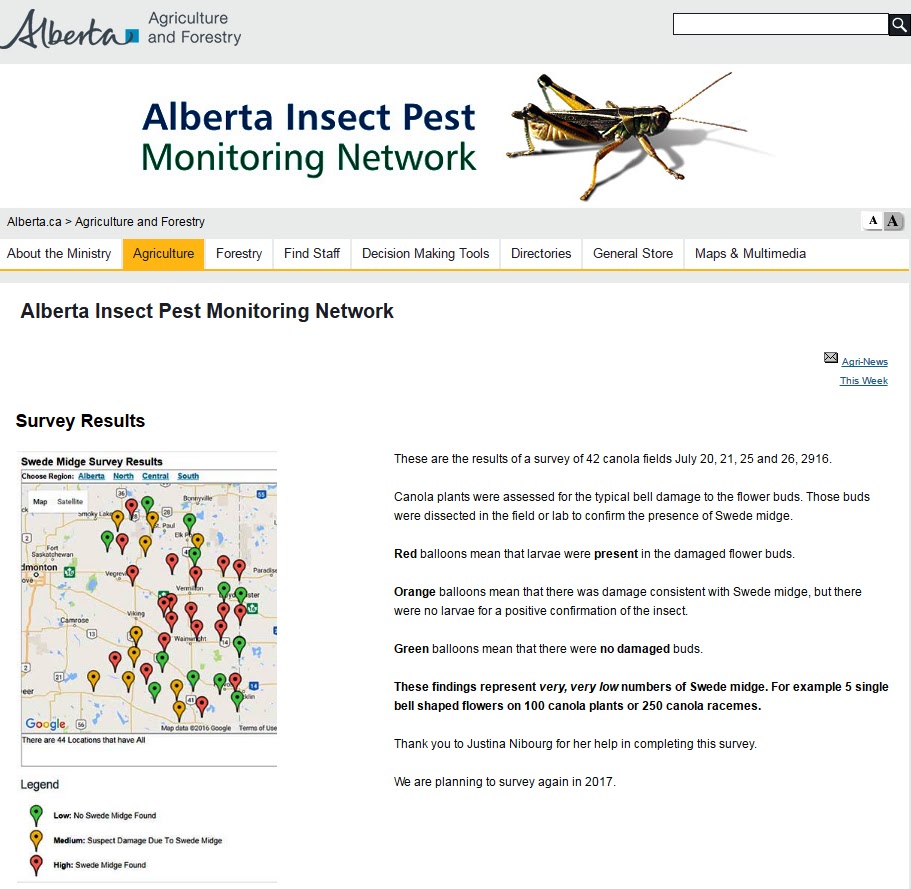
This summer, Alberta Agriculture & Forestry Staff performed a survey of 42 canola sites in central Alberta on July 20, 21, 25, and 26 of 2016 and detected larvae within flower buds at multiple sites but ALWAYS AT LOW DENSITIES.  

At each site, buds on canola plants were assessed for typical bell damage then dissected either in the field or later in the laboratory to determine if midge larvae were present.  Results of the survey are described and mapped with the incidence of either:  
   1) buds with swede midge-type damage and containing larvae, or
   2) buds with swede midge-type damage but containing no larvae, or 
   3) no buds buds showing swede midge-type damage.
Review Alberta Agriculture & Forestry's 2016 canola midge survey methods and map here.  A screenshot (retrieved 07Sep2016) is below for reference.


Watch for survey results from Saskatchewan!  The preliminary data indicates the distribution of midge in canola within Saskatchewan has increased in 2016 compared to 2015.

Find more swede midge information:
- Refer to the Canola Watch article by Dr. Julie Soroka or review the new Ontario fact sheet produced by Baute et al. 2016.  

- Review the previous Weekly Update post for swede midge from Week 16 in 2016. 

- Review the swede midge page from the new Field Guide.  A screen shot is included below for reference.


Access the above swede midge page within the new "Field Crop and Forage Pests and their Natural Enemies in Western Canada: Identification and management field guide" - both English-enhanced or French-enhanced versions are available for free - download them!