The 2017 Prairie-Wide Risk and Forecast Maps can be viewed and downloaded here. Maps are generated for bertha armyworm, grasshoppers, wheat midge, cabbage seedpod weevil, pea leaf weevil, wheat stem sawfly, diamondback moth as well as average temperature, average precipitation, and modeled soil moisture for the Canadian prairies.
Thank you to the many people who monitor each growing season! An astonishing 6414 survey stops were involved in the insect monitoring performed across the Canadian prairies in 2016!
Showing posts with label 2016. Show all posts
Friday, 7 April 2017
2017 Risk and Forecast Maps for the Prairies
Labels:
2016,
2017,
Bertha armyworm,
Cabbage seedpod weevil,
Canola,
Diamondback moth,
FORECAST MAPS,
Grasshopper,
Pea,
Pea leaf weevil,
RISK MAPS,
Wheat,
Wheat midge,
Wheat stem sawfly
Location:
Canada
Monday, 13 February 2017
Manitoba insect survey and forecast maps - J. Gavloski
Manitoba posts their 2016 Insect Survey and 2017 Forecast Maps up on their website! Take a moment to look over the following forecasts:
Manitoba growers can access general information on pest and beneficial insects from a series of fact sheets posted at the Insect section of their website.
More information related to the above maps and insects can be obtained by contacting Manitoba Agriculture entomologist John Gavloski.
- Manitoba Grasshopper Forecast Map for 2017.
- Risk Forecast for Bertha Armyworm in Manitoba in 2016.
- Diamondback Moth Monitoring Program in Manitoba - 2016.
Manitoba growers can access general information on pest and beneficial insects from a series of fact sheets posted at the Insect section of their website.
More information related to the above maps and insects can be obtained by contacting Manitoba Agriculture entomologist John Gavloski.
Labels:
2016,
2017,
Bertha armyworm,
Canola,
Diamondback moth,
FORECAST MAPS,
Grasshopper,
Manitoba,
RISK MAPS
Location:
Manitoba, Canada
Friday, 10 February 2017
Saskatchewan Insect Survey and Forecast Maps are available on Saskatchewan.ca - Hartley, Stephens
All the Saskatchewan Insect Survey and Forecast Maps and more can be found on Saskatchewan.ca ! To view all our agriculture maps check out our Maps for Farmers and Agribusiness section.
The Saskatchewan 2016 Bertha Armyworm moth accumulation map is posted.
The Saskatchewan 2016 Cabbage Seedpod Weevil Survey Map is posted.
Saskatchewan's 2016 Pea Leaf weevil Survey Map can be viewed.
The Saskatchewan 2017 Grasshopper Forecast Map is posted now.
Also, the Saskatchewan 2017 Wheat Midge Forecast Map is posted now.
Saskatchewan growers can access general Insect pest information located under our Crop Protection section.
More information related to the above maps and insects can be obtained by contacting Saskatchewan Agriculture's Scott Hartley or Danielle Stephens.
The Saskatchewan 2016 Bertha Armyworm moth accumulation map is posted.
The Saskatchewan 2016 Cabbage Seedpod Weevil Survey Map is posted.
Saskatchewan's 2016 Pea Leaf weevil Survey Map can be viewed.
The Saskatchewan 2017 Grasshopper Forecast Map is posted now.
Also, the Saskatchewan 2017 Wheat Midge Forecast Map is posted now.
Saskatchewan growers can access general Insect pest information located under our Crop Protection section.
More information related to the above maps and insects can be obtained by contacting Saskatchewan Agriculture's Scott Hartley or Danielle Stephens.
Monday, 6 February 2017
New insect species found in canola flowers in Saskatchewan and Alberta - Mori, Vankosky
Researchers at Agriculture and Agri-Food Canada’s Saskatoon Research and Development Centre (SRDC), along with colleagues at the University of Guelph, Alberta Agriculture and Forestry, and the Canadian Food Inspection Agency found a new insect damaging canola in northeastern Saskatchewan and east-central Alberta. The new species, a midge, which has yet to be named and scientifically described, belongs to the genus Contarinia. It is similar in appearance to the swede midge, Contarinia nasturtii, commonly found in Ontario.
Currently, the only confirmed symptom of damage by this insect are “bottle”-shaped galled flowers that form as a result of larval feeding inside flowers. Damaged flowers do not produce pods or seeds.
How the new species was confirmed
For years there have been accounts of differences between swede midge populations in Saskatchewan and Ontario, including adult size, the number of generations per year, and the type and amount of damage reported. These hints, combined with extremely low capture rates of adult swede midge in pheromone-baited traps in Saskatchewan despite apparently high rates of adult swede midge emergence caught the attention of Dr. Boyd Mori, a trained chemical ecologist and new research scientist at the SRDC.
Dr. Mori collected adult midges from soil emergence cages and reared larvae found in infested flowers. The resulting adult midges were sent to preeminent North American swede midge researchers at the University of Guelph, Dr. Rebecca Hallett and James Heal who immediately noticed differences between the midge from Saskatchewan and swede midges from Ontario: midges from Saskatchewan were more robust, had hairier wings and had slight differences in the antennae and genitalia compared to the swede midge.
These differences were confirmed by midge expert Dr. Bradley Sinclair with the Canadian Food Inspection Agency in Ottawa who also found several other physical differences. Using morphological differences, and DNA sequencing, the researchers concluded that the Saskatchewan midges were a separate species from the swede midge.
Economic Importance
While midge damage observed in Saskatchewan in 2016 appeared to be low in most fields, the economic impact of the new Contarinia midge is not known. Understanding pests and pest management is a priority of Agriculture and Agri-Food Canada and work is underway to formally describe and name this new species.
Questions? Contact Dr. Boyd Mori or Dr. Meghan Vankosky
Link here to access a brief bio for Dr. Boyd Mori and Dr. Meghan Vankosky.
Currently, the only confirmed symptom of damage by this insect are “bottle”-shaped galled flowers that form as a result of larval feeding inside flowers. Damaged flowers do not produce pods or seeds.
How the new species was confirmed
For years there have been accounts of differences between swede midge populations in Saskatchewan and Ontario, including adult size, the number of generations per year, and the type and amount of damage reported. These hints, combined with extremely low capture rates of adult swede midge in pheromone-baited traps in Saskatchewan despite apparently high rates of adult swede midge emergence caught the attention of Dr. Boyd Mori, a trained chemical ecologist and new research scientist at the SRDC.
Dr. Mori collected adult midges from soil emergence cages and reared larvae found in infested flowers. The resulting adult midges were sent to preeminent North American swede midge researchers at the University of Guelph, Dr. Rebecca Hallett and James Heal who immediately noticed differences between the midge from Saskatchewan and swede midges from Ontario: midges from Saskatchewan were more robust, had hairier wings and had slight differences in the antennae and genitalia compared to the swede midge.
These differences were confirmed by midge expert Dr. Bradley Sinclair with the Canadian Food Inspection Agency in Ottawa who also found several other physical differences. Using morphological differences, and DNA sequencing, the researchers concluded that the Saskatchewan midges were a separate species from the swede midge.
Economic Importance
While midge damage observed in Saskatchewan in 2016 appeared to be low in most fields, the economic impact of the new Contarinia midge is not known. Understanding pests and pest management is a priority of Agriculture and Agri-Food Canada and work is underway to formally describe and name this new species.
Questions? Contact Dr. Boyd Mori or Dr. Meghan Vankosky
Link here to access a brief bio for Dr. Boyd Mori and Dr. Meghan Vankosky.
Labels:
2016,
Alberta,
Canola,
Midge,
Saskatchewan
Location:
Canada
Thursday, 2 February 2017
Alberta 2017 Forecast and 2016 Risk Maps plus updates to Alberta Agriculture and Forestry web pages - Meers, Barkley
Alberta has posted their forecast and survey maps for several insect pest species occurring in field crops. Visit their home page to view all the Alberta maps.
The following list and hyperlinks were provided by Shelley Barkley via the Alberta Insect Pest Monitoring Network.
Scott Meers, entomologist with Alberta Agriculture and Forestry, was interviewed and spoke about Alberta insect forecasts for 2017. That series of five interviews can be access with the following hyperlinks:
Additionally, Alberta Agriculture and Forestry has updated their webpages with the following:
The following list and hyperlinks were provided by Shelley Barkley via the Alberta Insect Pest Monitoring Network.
Scott Meers, entomologist with Alberta Agriculture and Forestry, was interviewed and spoke about Alberta insect forecasts for 2017. That series of five interviews can be access with the following hyperlinks:
- 2017 Wheat Stem Sawfly and Cabbage Seedpod Weevil Forecasts
- 2017 Pea Leaf Weevil Forecast
- 2017 Wheat Midge Forecast
- 2017 Bertha Armyworm Forecast
- Grasshoppers
Additionally, Alberta Agriculture and Forestry has updated their webpages with the following:
- They have created a graphic that illustrates the "range expansion" of 2 evil weevils in Alberta: pea leaf and cabbage seedpod.
- Similar graphics have been added to their bertha armyworm page. Check out the past "six years of bertha armyworm moth" in Alberta which can be accessed via an hyperlink positioned on their bertha armyworm web page.
- Their grasshopper page has been updated too - check out the "historic grasshopper maps" for Alberta via a hyperlink located on their grasshopper web page.
- The past "eight years of sawfly" in Alberta can be accessed via a hyperlink located on their wheat stem sawfly web page.
- Remember, if you have access to a large format printer, a poster of the 6 Alberta insect forecast maps is available to print.
Thursday, 24 November 2016
2016 Swede Midge Pheromone Monitoring - Olfert, Mori, Vankosky
In 2016, swede midge pheromone traps were deployed at 62 sites across the Prairie region to monitor adult populations of this brassica pest. Of the 62 trap sites, two were located in BC, 13 in Alberta, 29 in Saskatchewan (where positive swede midge identifications were made in 2007 and 2009), and 13 in Manitoba. The map below illustrates trap site locations in 2016.
None of the traps were positive for swede midge in 2016.
We are grateful to all of the producers, agronomists, and cooperators who participated in the 2016 swede midge monitoring project. Without your assistance, we could not have supported such a thorough and widespread pheromone monitoring program.
We also extend our thanks to Nancy Melnychuk (AAFC-Saskatoon) for organizing the program, distributing trapping materials, and processing returned sticky cards for adult swede midge.
Because of the serious threat that swede midge poses to canola production, it is vital that monitoring for swede midge continues across the Prairies. At this time, plans are being made for the 2017 swede midge monitoring program. Agrologists or growers interested in performing weekly monitoring in 2017 are encouraged to email either your provincial entomologist or the survey researchers hyperlinked below for more information.
Owen Olfert (AAFC-Saskatoon)
Boyd Mori (AAFC-Saskatoon)
Meghan Vankosky (AAFC-Saskatoon)
John Gavloski (Manitoba Agriculture)
Scott Hartley (Saskatchewan Agriculture)
Scott Meers (Alberta Agriculture & Forestry)
None of the traps were positive for swede midge in 2016.
We are grateful to all of the producers, agronomists, and cooperators who participated in the 2016 swede midge monitoring project. Without your assistance, we could not have supported such a thorough and widespread pheromone monitoring program.
We also extend our thanks to Nancy Melnychuk (AAFC-Saskatoon) for organizing the program, distributing trapping materials, and processing returned sticky cards for adult swede midge.
Because of the serious threat that swede midge poses to canola production, it is vital that monitoring for swede midge continues across the Prairies. At this time, plans are being made for the 2017 swede midge monitoring program. Agrologists or growers interested in performing weekly monitoring in 2017 are encouraged to email either your provincial entomologist or the survey researchers hyperlinked below for more information.
Owen Olfert (AAFC-Saskatoon)
Boyd Mori (AAFC-Saskatoon)
Meghan Vankosky (AAFC-Saskatoon)
John Gavloski (Manitoba Agriculture)
Scott Hartley (Saskatchewan Agriculture)
Scott Meers (Alberta Agriculture & Forestry)
More information about swede midge can be found by:
• Referring to the Canola Watch article by Dr. Julie Soroka or accessing a new Ontario fact sheet produced by Baute et al. 2016.
• Accessing the swede midge pages within the new Field Guide which is available as a free download in either English or French.
• Referring to the Canola Watch article by Dr. Julie Soroka or accessing a new Ontario fact sheet produced by Baute et al. 2016.
• Accessing the swede midge pages within the new Field Guide which is available as a free download in either English or French.

Labels:
2016,
Alberta,
BC Peace,
Canola,
Manitoba,
RISK MAPS,
Saskatchewan,
Swede midge
Location:
Canada
Wednesday, 2 November 2016
2016 Harvest in western Canada
The Canadian Grain Commission holds and generates a wealth of information related to harvest in Canada AND they have one of the best Stored Product Pest online resources which includes a photographic identification key plus grain management tips.
It doesn't matter if you're an entomologist, an agrologist, or one of our hard-working growers - we all pay attention to harvest and here's what the CGC is able to share with us as of October 27, 2016:
- Quality data and statistics for western Canadian BARLEY
- Quality data for western Canadian CANOLA
- Quality data for western Canadian FLAXSEED
- Preliminary quality data for western Canadian LENTILS
- Preliminary quality data for western Canadian PEAS
- Quality data for western Canadian WHEAT (western Amber Durum or western spring Red)
Visit the Canadian Grain Commission's homepage for more!
Sunday, 16 October 2016
Upcoming Meetings and Conferences (2016-17)
Upcoming Meetings and Conferences – The following agricultural insect pest-related meetings and conferences are scheduled for this year:
• October 19-21, 2016: The Western Forum on Pest Management 2016 meets at Saskatoon SK. Check http://www.westernforum.org/WCCPAnnualMeeting.html for more information. You can review the Western Committee on Crop Pests agenda and watch for the Western Committee on Plant Diseases agenda to be posted on the homepage. Registration for this event is online and accessible here.
• October 21, 2016: The Canadian Forum for Biological Control will meet immediately following the Western Forum on Pest Management at Saskatoon SK the afternoon of October 21, 2016.
• October 25-27, 2016: 2016 Canola Discovery Forum will be held at Winnipeg MB. Registration information is located at: https://www.regonline.com/builder/site/Default.aspx?EventID=1862073
• October 27-29, 2016: The annual meeting of the Entomological Society of Alberta will be held at Calgary AB. Details are posted at: http://www.entsocalberta.ca/annmeet.htm
• October 28-29, 2016: The annual meeting of the Entomological Society of Manitoba will be held at Winnipeg MB. Details have been posted at: https://home.cc.umanitoba.ca/~fieldspg/index.html
• TBA: Refer to the Entomological Society of Saskatchewan’s website for upcoming events. Information will be posted at: http://www.entsocsask.ca/events.html
• November 22-24, 2016: The Canadian Weed Science Society meets in Moncton NB and more information is available at http://weedscience.ca/meeting-home/
• January 9-11, 2017: CropSphere Agricultural Conference will be held at Saskatoon SK. More information is available at: http://www.cropsphere.com/
• January 17-19, 2017: The Manitoba Ag Days show will be held at Brandon MB. More information will be available at: https://www.agdays.com/
• January 31-February 2, 2017: Registration for FarmTech 2017 opens November 10, 2016! Register by linking to the website at: http://farmtechconference.com/ .
• October 19-21, 2016: The Western Forum on Pest Management 2016 meets at Saskatoon SK. Check http://www.westernforum.org/WCCPAnnualMeeting.html for more information. You can review the Western Committee on Crop Pests agenda and watch for the Western Committee on Plant Diseases agenda to be posted on the homepage. Registration for this event is online and accessible here.
• October 21, 2016: The Canadian Forum for Biological Control will meet immediately following the Western Forum on Pest Management at Saskatoon SK the afternoon of October 21, 2016.
• October 25-27, 2016: 2016 Canola Discovery Forum will be held at Winnipeg MB. Registration information is located at: https://www.regonline.com/builder/site/Default.aspx?EventID=1862073
• October 27-29, 2016: The annual meeting of the Entomological Society of Alberta will be held at Calgary AB. Details are posted at: http://www.entsocalberta.ca/annmeet.htm
• October 28-29, 2016: The annual meeting of the Entomological Society of Manitoba will be held at Winnipeg MB. Details have been posted at: https://home.cc.umanitoba.ca/~fieldspg/index.html
• TBA: Refer to the Entomological Society of Saskatchewan’s website for upcoming events. Information will be posted at: http://www.entsocsask.ca/events.html
• November 22-24, 2016: The Canadian Weed Science Society meets in Moncton NB and more information is available at http://weedscience.ca/meeting-home/
• January 9-11, 2017: CropSphere Agricultural Conference will be held at Saskatoon SK. More information is available at: http://www.cropsphere.com/
• January 17-19, 2017: The Manitoba Ag Days show will be held at Brandon MB. More information will be available at: https://www.agdays.com/
• January 31-February 2, 2017: Registration for FarmTech 2017 opens November 10, 2016! Register by linking to the website at: http://farmtechconference.com/ .
Labels:
2016,
2017,
Meetings and conferences
Location:
Canada
Wednesday, 7 September 2016
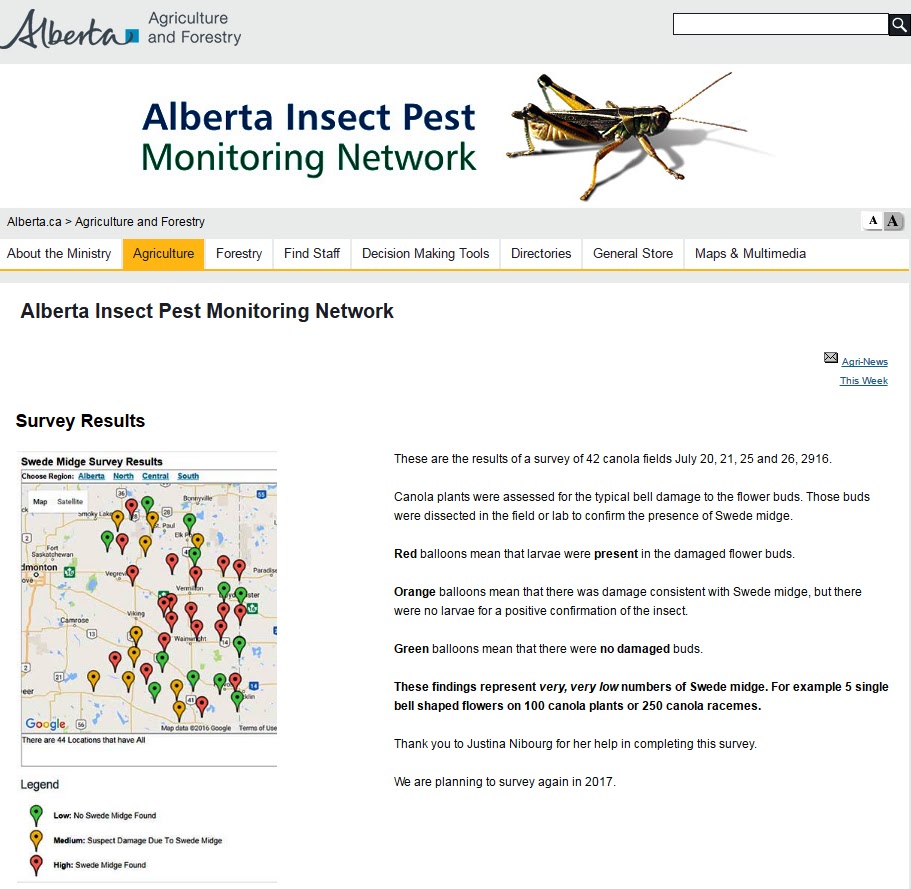
2016 Canola Midge Surveying in Alberta
This summer, Alberta Agriculture & Forestry Staff performed a survey of 42 canola sites in central Alberta on July 20, 21, 25, and 26 of 2016 and detected larvae within flower buds at multiple sites but ALWAYS AT LOW DENSITIES.
At each site, buds on canola plants were assessed for typical bell damage then dissected either in the field or later in the laboratory to determine if midge larvae were present. Results of the survey are described and mapped with the incidence of either:
1) buds with swede midge-type damage and containing larvae, or
2) buds with swede midge-type damage but containing no larvae, or
3) no buds buds showing swede midge-type damage.
Review Alberta Agriculture & Forestry's 2016 canola midge survey methods and map here. A screenshot (retrieved 07Sep2016) is below for reference.
Watch for survey results from Saskatchewan! The preliminary data indicates the distribution of midge in canola within Saskatchewan has increased in 2016 compared to 2015.
Find more swede midge information:
- Refer to the Canola Watch article by Dr. Julie Soroka or review the new Ontario fact sheet produced by Baute et al. 2016.
- Review the previous Weekly Update post for swede midge from Week 16 in 2016.
- Review the swede midge page from the new Field Guide. A screen shot is included below for reference.
Access the above swede midge page within the new "Field Crop and Forage Pests and their Natural Enemies in Western Canada: Identification and management field guide" - both English-enhanced or French-enhanced versions are available for free - download them!
At each site, buds on canola plants were assessed for typical bell damage then dissected either in the field or later in the laboratory to determine if midge larvae were present. Results of the survey are described and mapped with the incidence of either:
1) buds with swede midge-type damage and containing larvae, or
2) buds with swede midge-type damage but containing no larvae, or
3) no buds buds showing swede midge-type damage.
Review Alberta Agriculture & Forestry's 2016 canola midge survey methods and map here. A screenshot (retrieved 07Sep2016) is below for reference.
Watch for survey results from Saskatchewan! The preliminary data indicates the distribution of midge in canola within Saskatchewan has increased in 2016 compared to 2015.
Find more swede midge information:
- Refer to the Canola Watch article by Dr. Julie Soroka or review the new Ontario fact sheet produced by Baute et al. 2016.
- Review the previous Weekly Update post for swede midge from Week 16 in 2016.
- Review the swede midge page from the new Field Guide. A screen shot is included below for reference.
Access the above swede midge page within the new "Field Crop and Forage Pests and their Natural Enemies in Western Canada: Identification and management field guide" - both English-enhanced or French-enhanced versions are available for free - download them!
Labels:
2016,
Alberta,
Canola,
Canola flower midge,
Swede midge
Location:
Alberta, Canada
Monday, 29 August 2016
Insect of the Week (Aug 29, 2016) - Predatory mites
Predatory mites
Last year, the focus of the Insect of the Week was crop pests. This year, we’re changing things up and highlighting the many natural enemies that help you out, silently and efficiently killing off crop pests. [note: featured Insects of the Week in 2015 are available on the Insect of the Week page]
This week’s feature natural enemies are predatory mites. These are not insects but instead belong to the Arachnid or spider class of arthropods. My known encounters with mites have been of the pest type (e.g. two-spotted spider mite), spinning their webs and literally sucking the life out of their host plants and transmitting viruses. But this group, the predatory mites get their meal instead from insect eggs, all stages of pest mites, thrips, young aphids and leafhoppers. They may be small, but they are ‘mity’.
For more information about these natural enemies, other pests they control and other important crop and forage insects, see the new Field Crop and Forage Pests and their Natural Enemies in Western Canada - Identification and Management Field Guide for identification, life cycle and conservation options (download links for field guide available on the Insect of the Week page).
Adult whirligig mite,
Aleksander Balodis (AfroBrazillian), Wikimedia Commons
Adult red velvet mite,
Jorg Hempel, Wikimedia Commons
Thursday, 25 August 2016
Weekly Update (August 24, 2016; Wk 17) - Otani, Giffen, Weiss, Olfert
Greetings!
This is the last Weekly Update of the 2016 growing season! Many thanks to everyone who helped prepare the various sections and insect pest updates for the past 17 weeks! Thanks to those of you who monitor and good luck with harvest!
A downloadable PDF version of the complete Weekly Update for Week 17 (August 24, 2016) can be accessed here.
Subscribe to the Blog by following the instructions posted here! Receive automatic updates during the fall and winter months in your inbox.
Questions or problems accessing the contents of this Weekly Update? Please e-mail either Dr. Owen Olfert or Jennifer Otani. Past “Weekly Updates” are very kindly archived to the Western Forum website by webmaster, Dr. Kelly Turkington.
This is the last Weekly Update of the 2016 growing season! Many thanks to everyone who helped prepare the various sections and insect pest updates for the past 17 weeks! Thanks to those of you who monitor and good luck with harvest!
A downloadable PDF version of the complete Weekly Update for Week 17 (August 24, 2016) can be accessed here.
Subscribe to the Blog by following the instructions posted here! Receive automatic updates during the fall and winter months in your inbox.
Labels:
2016,
WEEKLY UPDATE,
WU-2016 Wk17 (Aug24)
Location:
Canada
Weekly Update (Aug 24, 2016; Wk 17) - Weather Synopsis
Weather synopsis – The updated growing degree day map (GDD) (Base 5ºC, March 1 – August 21, 2016) is below:
While the growing degree day map (GDD) (Base 10ºC, March 1 – August 21, 2016) is below:
The map below shows the Lowest Temperatures the Past 7 Days (August 17-23, 2016) across the prairies:
The maps above are all produced by Agriculture and Agri-Food Canada. Growers may wish to bookmark the AAFC Drought Watch Maps for the growing season.
Additional precipitation and temperature data or maps are provided by the following:
Manitoba Agriculture's Crop Weather Report
Alberta Agriculture and Food's Weather Stations
Saskatchewan's Cumulative Precipitation Map
Environment Canada's Historical Data Interface
While the growing degree day map (GDD) (Base 10ºC, March 1 – August 21, 2016) is below:
The map below shows the Lowest Temperatures the Past 7 Days (August 17-23, 2016) across the prairies:
The map below shows the Highest Temperatures the Past 7 Days (August 17-23, 2016):
The maps above are all produced by Agriculture and Agri-Food Canada. Growers may wish to bookmark the AAFC Drought Watch Maps for the growing season.
Additional precipitation and temperature data or maps are provided by the following:
Manitoba Agriculture's Crop Weather Report
Alberta Agriculture and Food's Weather Stations
Saskatchewan's Cumulative Precipitation Map
Environment Canada's Historical Data Interface
Location:
Canada
Weekly Update (August 24, 2016; Wk 17) - Pre-Harvest Intervals (PHI)
Pre-Harvest Interval (PHI) -Reminder – Growers with late-season insect pest problems will need to remember to factor in the PHI which is the minimum number of days between a pesticide application and swathing or straight combining of a crop.
The PHI recommends sufficient time for a pesticide to break down and a PHI-value is both crop- and pesticide-specific. Adhering to the PHI is important for a number of health-related reasons but also because Canada’s export customers strictly regulate and test for the presence of trace residues of pesticides.
An excellent summary of PHI for various pesticides in their various crops was posted by Saskatchewan Agriculture this week within their Crop Production News.
In 2013, the Canola Council of Canada created and circulated their “Spray to Swath Interval Calculator” which was intended to help canola growers accurately estimate their PHI. Other PHI are described in your provincial crop protection guides and remember that specific crop x pesticide combinations will mean different PHIs. More information about PHI and Maximum Residue Limits (MRL) is available on the Canola Council of Canada's website.
The PHI recommends sufficient time for a pesticide to break down and a PHI-value is both crop- and pesticide-specific. Adhering to the PHI is important for a number of health-related reasons but also because Canada’s export customers strictly regulate and test for the presence of trace residues of pesticides.
An excellent summary of PHI for various pesticides in their various crops was posted by Saskatchewan Agriculture this week within their Crop Production News.
Labels:
2016,
PHI,
WEEKLY UPDATE,
WU-2016 Wk17 (Aug24)
Location:
Canada
Weekly Update (August 24, 2016; Wk 17) - Meet Dr. Haley Catton
Dr. Haley Catton joined AAFC-Lethbridge as a Research Scientist in Cereal Crop Entomology in April 2016. With a diverse background in studying trees, weeds, native plants, insects, and mammals, Haley specializes in population biology, insect-plant interactions, biological control, field experimentation and analysis of large data sets. Originally from Winnipeg, Haley earned a B.Sc. (Agriculture) and M.Sc. (Plant Science) from the University of Manitoba, a Ph.D. (Insect-Plant Interactions) from the University of British Columbia Okanagan, and conducted postdoctoral research at the University of Lethbridge. Her research program at AAFC will draw from all of these experiences to focus on pest and beneficial insects in cereal crops on the prairies. Her target pests range from established problems like wheat stem sawfly and wireworm to emerging pests such as the invasive cereal leaf beetle.
Haley wants to connect with producers and hear about your priorities for research. Follow her on Twitter at @haleycatton or reach her at haley.catton@canada.ca or 403.317.3404. Fair warning: Haley is a diehard Blue Bombers fan… Saskatchewan Roughriders fans beware.
Weekly Update (August 24, 2016; Wk 17) - Meet Dr. Meghan Vankosky
Dr. Meghan Vankosky started her position as a research scientist with Agriculture and Agri-Food Canada at the Saskatoon Research and Development Centre on July 18, 2016. Most recently, Meghan worked as a postdoctoral scholar at the University of California, Riverside. Her work there focused on establishing a release program for a parasitoid used for biological control of the Asian citrus psyllid in southern California, and on studying the competitive interactions of that parasitoid with another primary parasitoid of the pest. In the past, Meghan studied the behavior and life history of an omnivore used for biological control at the University of Windsor in Ontario (Ph.D., 2010-2015), and integrated pest management strategies and biological control of the pea leaf weevil at the University of Alberta (M.Sc., 2008-2010).
As a field crop entomologist with AAFC, Meghan hopes to develop a strong IPM-based research program that focuses on understanding insect pests and developing sustainable management programs that will benefit both producers and the environment. She currently plans to investigate the impact of the pea leaf weevil and assess management options for this pest in Saskatchewan. She will also be involved with a project studying the life history and impact of the swede midge in canola crops in the Prairies.
Meghan can be reached at 1.306.385-9362 or Meghan.Vankosky@canada.ca.
As a field crop entomologist with AAFC, Meghan hopes to develop a strong IPM-based research program that focuses on understanding insect pests and developing sustainable management programs that will benefit both producers and the environment. She currently plans to investigate the impact of the pea leaf weevil and assess management options for this pest in Saskatchewan. She will also be involved with a project studying the life history and impact of the swede midge in canola crops in the Prairies.
Meghan can be reached at 1.306.385-9362 or Meghan.Vankosky@canada.ca.
Weekly Update (August 24, 2016; Wk 17) - Meet Dr. Boyd Mori
Dr. Boyd Mori – (Research Scientist – Entomology) Boyd completed his PhD in 2014 at the University of Alberta on pheromone monitoring and management of the red clover casebearer (Coleophora deauratella) moth in the Peace River region of Alberta. He then undertook a Postdoctoral Fellowship at the Swedish University of Agricultural Sciences (Alnarp, Sweden) where he researched the chemical ecology of the highly invasive spotted wing fruit fly (Drosophila suzukii) with a focus on alternative pest management strategies. Boyd joined AAFC-Saskatoon in April 2016.
Boyd’s primary project will be on the ecology of swede midge-host plant interactions, where he aims to identify host plant resistance mechanisms against the swede midge, a potentially significant pest of canola. He is a strong proponent of integrated pest management and has a robust background in insect behaviour and physiology which he uses to develop monitoring and management tools for insect pests.
Boyd can be reached at 1.306.385.9398 or boyd.mori@canada.ca
Boyd’s primary project will be on the ecology of swede midge-host plant interactions, where he aims to identify host plant resistance mechanisms against the swede midge, a potentially significant pest of canola. He is a strong proponent of integrated pest management and has a robust background in insect behaviour and physiology which he uses to develop monitoring and management tools for insect pests.
Boyd can be reached at 1.306.385.9398 or boyd.mori@canada.ca
Weekly Update (August 24, 2016; Wk 17) - Meet Dr. Tyler Wist
Dr. Tyler Wist spent his early insect years killing mosquitoes before studying pollinators in Echinacea crops for his M.Sc. with Dr. Art Davis at the University of Saskatchewan. A Ph.D. from the University of Alberta with Dr. Maya Evenden taught him the unseen world of insect chemical ecology, and invasion dynamics and the parasitoid complex of a recently introduced lepidopteran pest, the ash leaf coneroller. Drs. Chrystel Olivier and Owen Olfert brought him in on an NSERC Visiting Fellowship on the cereal aphid project and then had him chasing leafhoppers in cereal and canola crops. Tyler is the current President of the Entomological Society of Saskatchewan and has begun a research scientist position at Agriculture and Agri-Food Canada’s Research and Development Centre in Saskatoon as a Field Crop Entomologist on January 25th 2016.
Tyler is working on developing a dynamic action threshold for cereal aphids that incorporates the predatory pressure of natural enemies, determining the economic threshold and effect of landscapes on flea beetles in newer, hybrid canola varieties, and tracking aster leafhopper populations and aster yellows infection in canola and cereal crops. He is also investigating new integrated pest management tools for wheat midge and chasing Lygus bugs in canola and aphids in pulse crops.
Tyler can be reached at Tyler.Wist@agr.gc.ca or 306.385.9379.
Tyler is working on developing a dynamic action threshold for cereal aphids that incorporates the predatory pressure of natural enemies, determining the economic threshold and effect of landscapes on flea beetles in newer, hybrid canola varieties, and tracking aster leafhopper populations and aster yellows infection in canola and cereal crops. He is also investigating new integrated pest management tools for wheat midge and chasing Lygus bugs in canola and aphids in pulse crops.
Tyler can be reached at Tyler.Wist@agr.gc.ca or 306.385.9379.
Weekly Update (August 24, 2016; Wk 17) - West Nile Virus and Culex tarsalis
West Nile Virus Risk – The regions most advanced in degree-day accumulations for Culex tarsalis, the vector for West Nile Virus, are shown in the map below. As of August 21, 2016, areas highlighted in yellow, orange, or red on the map below have accumulated sufficient heat for C. tarsalis to fly so wear your DEET to stay protected!
The Public Health Agency of Canada posts information related to West Nile Virus in Canada. The map of clinical cases of West Nile Virus in Canada in 2016 is posted (as of July 23, 2016) while a screen shot is provided below (posted August 22, 2016).
The Canadian Wildlife Health Cooperative compiles and posts information related to their disease surveillance for West Nile Virus. As of August 22, 2016, 36 birds were submitted for testing and two have tested positive for West Nile virus in Ontario.
The Public Health Agency of Canada posts information related to West Nile Virus in Canada. The map of clinical cases of West Nile Virus in Canada in 2016 is posted (as of July 23, 2016) while a screen shot is provided below (posted August 22, 2016).
The Canadian Wildlife Health Cooperative compiles and posts information related to their disease surveillance for West Nile Virus. As of August 22, 2016, 36 birds were submitted for testing and two have tested positive for West Nile virus in Ontario.
Labels:
2016,
Culex tarsalis,
Mosquito,
WEEKLY UPDATE,
West Nile virus
Location:
Canada
Weekly Update (August 24, 2016; Wk 17) - Crop reports
Crop reports are produced by:
- Manitoba Agriculture, Rural Development (August 24, 2016).
- Saskatchewan Agriculture Crop Report (August 15, 2016) is posted online and as a printer-friendly version.
The USDA also produces a World Agricultural Production Report (August 2016) which estimates production across the globe for corn, cotton, rapeseed, and wheat but also includes tabular data for other grains.
- Manitoba Agriculture, Rural Development (August 24, 2016).
- Saskatchewan Agriculture Crop Report (August 15, 2016) is posted online and as a printer-friendly version.
- Alberta Agriculture and Forestry (for August 16, 2016) which also posts a printer-friendly version.
The USDA publishes a Crop Production Report (Posted August 12, 2016) and a Crop Progress Report (posted August 22, 2016) which includes harvest and condition ratings for winter wheat, spring wheat, oat, barley, plus range and pasture conditions.
Location:
Canada
Subscribe to:
Posts (Atom)