- Welcome to our new website!
- Weather synopsis
- Predicted wheat midge development
- Predicted grasshopper development
- Bertha armyworm monitoring
- Diamondback moth
- Pea leaf weevil
- Cereal aphid manager
- West nile virus risk
- Scouting charts for canola and flax
- Field heroes
- Provincial insect pest reports
- Crop reports
- Previous posts
- Insect of the Week: Forage grass pests / Dr. Chrystel Olivier
- AND CONGRATULATIONS to the Prairie Crop Disease Monitoring Network on their new Blog!
Showing posts with label Wheat midge. Show all posts
Showing posts with label Wheat midge. Show all posts
Friday, 10 July 2020
Weekly Update links to the NEW website
Click each topic below to access the entire WEEKLY UPDATE (June 9, 2020 for Week 11) over at the NEW WEBSITE!

Friday, 3 July 2020
John Frederick Doane (14 April 1930 – 21 May 2020)
In memory
John Frederick Doane quietly passed away on May 21, 2020, in his home in Saskatoon, at the age of 90 years. Having grown up on a farm north of Toronto, John developed an interest in entomology at a young age, and began collecting insect specimens common to southern Ontario. John received his B.S.A. in 1954 from the Ontario Agricultural College, now the University of Guelph; specializing in entomology. Pursuing these interests, John immediately enrolled in graduate studies at the University of Wisconsin, completing both his M.Sc. (1956) and his Ph.D. (1958). Shortly after graduating, he began a research career in agricultural entomology, receiving an Research Scientist position at the Agriculture Canada Research Station in Saskatoon that same year. Interestingly, this cadre of Research Scientists at the Centre still had a significant number of first generation entomologists appointed to the Dominion Entomological Laboratory at Saskatoon.
John adapted very quickly to the agricultural industry on the prairies, and his research over the years has significantly contributed to insect population monitoring. His first research assignment was to assess and describe the ecology and behaviour of wireworms, a major pest of field crops at the time. John began by investigating the ovipositional behaviour and fecundity of adults, as well as the effects of soil moisture and temperature on wireworm egg survival. His studies, related to the response of wireworm larvae to carbon dioxide levels, contributed to the development of trapping and monitoring tools for larval populations. In the early 1980s, Saskatchewan experienced an unexpected outbreak of wheat midge (Sitodiplosis mosellana). John was asked to assemble a multidisciplinary research team with the objectives to determine the biology and ecology of this new threat to wheat production in the prairies. His research promptly yielded important contributions: (i) the discovery of a significant biological control insect (Macroglenes penetrans), and (ii) the development of a sound wheat midge population monitoring protocol. Through the successful implementation of conservation techniques, M. penetrans now controls an average of >30% of the wheat midge across Saskatchewan annually. A study in the 1990s, showed that the dollar value of the parasitoid to the agriculture industry over the 10 years, was in excess of $248.3 million (equivalent of $422.5 million today). The second highlight, a soil extraction protocol for wheat midge larval cocoons, provided a unique population density and distribution monitoring tool for both the pest wheat midge and it’s biological control agent. This tool is still utilized today to forecast the risk to wheat production; the survey results being provided as mapped forecasts for producers on an annual basis. Given the success of biological control agent (M. penetrans), John collaborated with international colleagues at CABI in Switzerland, to assess the viability of importing a second biocontrol agent for control of wheat midge. This resulted in the successful introduction and establishment of Platygaster tuberosula. In the late 1980s, wheat production south of the USA border was seriously threatened by Russian wheat aphid (Diuraphis noxia). In response to this new threat, John manufactured and installed a series of suction traps as an early-warning system, from southern to northern Saskatchewan. The 30ft high traps were designed to collect migratory aphid adults being transported north on wind currents from infestations in the USA. The results indicated that southwest SK was occasionally at low risk, but the threat was significantly less than south of the border.
John was appointed Head of the Integrated Pest Management Section of the Saskatoon Research Station in 1982, and the Head of the amalgamated Cereals Protection Section in 1989. John served as E.S.S. President in 1967 and 1978, and served a term as a member of the E.S.C. Governing Board. He will also be remembered as a founding member of the national AAFC Biological Control Working Group, a group that is still very active in 2020. He retired in 1993, taking an extended self-guided tour of south east Asia, including India and Malaysia. Upon his return, John remained active in retirement, co-authoring several scientific articles, most recently a bio-climate modelling paper on wheat midge in 2020.
- Submitted by O. Olfert
John Frederick Doane quietly passed away on May 21, 2020, in his home in Saskatoon, at the age of 90 years. Having grown up on a farm north of Toronto, John developed an interest in entomology at a young age, and began collecting insect specimens common to southern Ontario. John received his B.S.A. in 1954 from the Ontario Agricultural College, now the University of Guelph; specializing in entomology. Pursuing these interests, John immediately enrolled in graduate studies at the University of Wisconsin, completing both his M.Sc. (1956) and his Ph.D. (1958). Shortly after graduating, he began a research career in agricultural entomology, receiving an Research Scientist position at the Agriculture Canada Research Station in Saskatoon that same year. Interestingly, this cadre of Research Scientists at the Centre still had a significant number of first generation entomologists appointed to the Dominion Entomological Laboratory at Saskatoon.
 |
| John Frederick Doane (14 April 1930 - 21 May 2020) Photo taken July 2019 |
John adapted very quickly to the agricultural industry on the prairies, and his research over the years has significantly contributed to insect population monitoring. His first research assignment was to assess and describe the ecology and behaviour of wireworms, a major pest of field crops at the time. John began by investigating the ovipositional behaviour and fecundity of adults, as well as the effects of soil moisture and temperature on wireworm egg survival. His studies, related to the response of wireworm larvae to carbon dioxide levels, contributed to the development of trapping and monitoring tools for larval populations. In the early 1980s, Saskatchewan experienced an unexpected outbreak of wheat midge (Sitodiplosis mosellana). John was asked to assemble a multidisciplinary research team with the objectives to determine the biology and ecology of this new threat to wheat production in the prairies. His research promptly yielded important contributions: (i) the discovery of a significant biological control insect (Macroglenes penetrans), and (ii) the development of a sound wheat midge population monitoring protocol. Through the successful implementation of conservation techniques, M. penetrans now controls an average of >30% of the wheat midge across Saskatchewan annually. A study in the 1990s, showed that the dollar value of the parasitoid to the agriculture industry over the 10 years, was in excess of $248.3 million (equivalent of $422.5 million today). The second highlight, a soil extraction protocol for wheat midge larval cocoons, provided a unique population density and distribution monitoring tool for both the pest wheat midge and it’s biological control agent. This tool is still utilized today to forecast the risk to wheat production; the survey results being provided as mapped forecasts for producers on an annual basis. Given the success of biological control agent (M. penetrans), John collaborated with international colleagues at CABI in Switzerland, to assess the viability of importing a second biocontrol agent for control of wheat midge. This resulted in the successful introduction and establishment of Platygaster tuberosula. In the late 1980s, wheat production south of the USA border was seriously threatened by Russian wheat aphid (Diuraphis noxia). In response to this new threat, John manufactured and installed a series of suction traps as an early-warning system, from southern to northern Saskatchewan. The 30ft high traps were designed to collect migratory aphid adults being transported north on wind currents from infestations in the USA. The results indicated that southwest SK was occasionally at low risk, but the threat was significantly less than south of the border.
John was appointed Head of the Integrated Pest Management Section of the Saskatoon Research Station in 1982, and the Head of the amalgamated Cereals Protection Section in 1989. John served as E.S.S. President in 1967 and 1978, and served a term as a member of the E.S.C. Governing Board. He will also be remembered as a founding member of the national AAFC Biological Control Working Group, a group that is still very active in 2020. He retired in 1993, taking an extended self-guided tour of south east Asia, including India and Malaysia. Upon his return, John remained active in retirement, co-authoring several scientific articles, most recently a bio-climate modelling paper on wheat midge in 2020.
- Submitted by O. Olfert
Predicted wheat midge development
Wheat Midge (Sitodiplosis mosellana) – Wheat midge overwinter as larval cocoons in the soil. Soil moisture conditions in May and June can have significant impact on wheat midge emergence. Adequate rainfall promotes termination of diapause and movement of larval to the sol surface where pupation occurs. Insufficient rainfall in May and June can result in delayed movement of larvae to the soil surface. Elliott et al. (2009) reported that wheat midge emergence was delayed or erratic if rainfall did not exceed 20-30 mm during May. Olfert et al. (2016) ran model simulations to demonstrate how rainfall impacts wheat midge population density. Our wheat midge model (Olfert et al. 2020) indicates that dry conditions may result in:
a. Delayed adult emergence and oviposition
b. Reduced numbers of adults and eggs
As of June 28, 2020, midge model runs indicate that, where midge are present, pupation is occurring across Alberta, northwest Saskatchewan and southern Manitoba (Fig. 1). Simulations suggest that the first adults might be emerging now (Fig. 2).
Alberta Agriculture and Forestry has a YouTube video describing in-field monitoring for wheat midge.
a. Delayed adult emergence and oviposition
b. Reduced numbers of adults and eggs
As of June 28, 2020, midge model runs indicate that, where midge are present, pupation is occurring across Alberta, northwest Saskatchewan and southern Manitoba (Fig. 1). Simulations suggest that the first adults might be emerging now (Fig. 2).
 |
| Figure 1. Predicted percent of population of wheat midge (Sitodiplosis mosellana) at pupal stage across the Canadian prairies (as of June 28, 2020). |
 |
| Figure 2. Predicted percent of population of wheat midge (Sitodiplosis mosellana) at adult stage across the Canadian prairies (as of June 28, 2020). |
Females lay eggs on developing wheat heads. This typically occurs in evenings when winds are calm. The wheat midge monitoring protocol suggests that wheat fields should be inspected for adults in late June and early July as wheat heads are emerging. The next three weeks are very important for monitoring wheat midge populations for the purpose of making management decisions.
Simulations were run to July 21 to assess population development over the next three weeks. The first two graphs illustrate that adult wheat midge populations near Saskatoon (Fig. 3) and Lacombe (Fig. 4) are expected to emerge on June 30 and July 1, respectively.
Oviposition will occur soon after adult emergence. Adult numbers are predicted to peak in mid July (Fig. 3 and 4). A comparison of the synchrony between wheat midge and wheat is represented in Figure 5 and indicates that adult emergence and oviposition may occur when the crop is most susceptible near Saskatoon. This information can be used as a guide to determine when fields should be monitored.
Information related to wheat midge biology and monitoring can be accessed by linking to your provincial fact sheet (Saskatchewan Agriculture or Alberta Agriculture & Forestry). A review of wheat midge on the Canadian prairies was published by Elliott, Olfert, and Hartley in 2011.
Simulations were run to July 21 to assess population development over the next three weeks. The first two graphs illustrate that adult wheat midge populations near Saskatoon (Fig. 3) and Lacombe (Fig. 4) are expected to emerge on June 30 and July 1, respectively.
 |
| Figure 3. Predicted wheat midge (Sitodiplosis mosellana) phenology at Saskatoon SK projected to July 21, 2020. |
 |
| Figure 4. Predicted wheat midge (Sitodiplosis mosellana) phenology at Lacombe AB projected to July 21, 2020. |
Oviposition will occur soon after adult emergence. Adult numbers are predicted to peak in mid July (Fig. 3 and 4). A comparison of the synchrony between wheat midge and wheat is represented in Figure 5 and indicates that adult emergence and oviposition may occur when the crop is most susceptible near Saskatoon. This information can be used as a guide to determine when fields should be monitored.
 |
| Figure 5. Comparison of predicted phenology of wheat midge (Sitodiplosis mosellana) and wheat at Saskatoon SK projected to July 21, 2020. |
Information related to wheat midge biology and monitoring can be accessed by linking to your provincial fact sheet (Saskatchewan Agriculture or Alberta Agriculture & Forestry). A review of wheat midge on the Canadian prairies was published by Elliott, Olfert, and Hartley in 2011.
Alberta Agriculture and Forestry has a YouTube video describing in-field monitoring for wheat midge.
More information about Wheat midge can be found by accessing the pages from the new "Field Crop and Forage Pests and their Natural Enemies in Western Canada: Identification and Field Guide". View ONLY the Wheat midge pages but remember the guide is available as a free downloadable document as both an English-enhanced or French-enhanced version.
Thursday, 25 June 2020
Predicted wheat midge development
Wheat Midge (Sitodiplosis mosellana) – Wheat midge overwinter as larval cocoons in the soil. Soil moisture conditions in May and June can have significant impact on wheat midge emergence. Adequate rainfall promotes termination of diapause and movement of larval to the sol surface where pupation occurs. Insufficient rainfall in May and June can result in delayed movement of larvae to the soil surface. Elliott et al. (2009) reported that wheat midge emergence was delayed or erratic if rainfall did not exceed 20-30 mm during May. Olfert et al. (2016) ran model simulations to demonstrate how rainfall impacts wheat midge population density. Our wheat midge model (Olfert et al. 2020) indicates that dry conditions may result in:
a. Delayed adult emergence and oviposition
b. Reduced numbers of adults and eggs
As of June 21, 2020, wheat midge model runs indicate that recent rainfall in Manitoba should result in development of wheat midge larvae (between Brandon and Winnipeg). These larvae (in the soil) are expected to be moving to the soil surface. Dry conditions across eastern Saskatchewan has delayed development of larval cocoons. Pupae are predicted to be appearing across Alberta.
The following graph illustrates that adult wheat midge populations in the Saskatoon area are expected to emerge on June 30th. Peak adult numbers are predicted to peak in mid July. Females lay eggs on developing wheat heads. This typically occurs in the evening when winds are calm. The wheat midge monitoring protocol suggests that wheat fields should be inspected for adults in late June and early July as wheat heads are emerging.
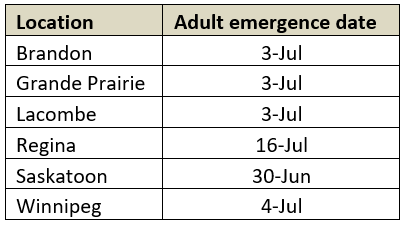
The following table provides an estimate of first occurrence of wheat midge adults and can be used as a guide to determine when fields should be monitored.

Information related to wheat midge biology and monitoring can be accessed by linking to your provincial fact sheet (Saskatchewan Agriculture or Alberta Agriculture & Forestry). A review of wheat midge on the Canadian prairies was published by Elliott, Olfert, and Hartley in 2011.
Alberta Agriculture and Forestry has a YouTube video describing in-field monitoring for wheat midge.
a. Delayed adult emergence and oviposition
b. Reduced numbers of adults and eggs
As of June 21, 2020, wheat midge model runs indicate that recent rainfall in Manitoba should result in development of wheat midge larvae (between Brandon and Winnipeg). These larvae (in the soil) are expected to be moving to the soil surface. Dry conditions across eastern Saskatchewan has delayed development of larval cocoons. Pupae are predicted to be appearing across Alberta.
 |
| Figure 1. Predicted percent of larval population of wheat midge (Sitodiplosis mosellana) at soil surface across the Canadian prairies (as of June 21, 2020). |
 |
| Figure 2. Predicted percent of population of wheat midge (Sitodiplosis mosellana) at pupal stage across the Canadian prairies (as of June 21, 2020). |
The following graph illustrates that adult wheat midge populations in the Saskatoon area are expected to emerge on June 30th. Peak adult numbers are predicted to peak in mid July. Females lay eggs on developing wheat heads. This typically occurs in the evening when winds are calm. The wheat midge monitoring protocol suggests that wheat fields should be inspected for adults in late June and early July as wheat heads are emerging.
 |
| Figure 3. Projected wheat midge (Sitdiplosis mosellana) phenology at Saskatoon SK as of June 30, 2020. |
The following table provides an estimate of first occurrence of wheat midge adults and can be used as a guide to determine when fields should be monitored.
Information related to wheat midge biology and monitoring can be accessed by linking to your provincial fact sheet (Saskatchewan Agriculture or Alberta Agriculture & Forestry). A review of wheat midge on the Canadian prairies was published by Elliott, Olfert, and Hartley in 2011.
Alberta Agriculture and Forestry has a YouTube video describing in-field monitoring for wheat midge.
More information about Wheat midge can be found by accessing the pages from the new "Field Crop and Forage Pests and their Natural Enemies in Western Canada: Identification and Field Guide". View ONLY the Wheat midge pages but remember the guide is available as a free downloadable document as both an English-enhanced or French-enhanced version.
Friday, 19 June 2020
Predicted wheat midge development
Wheat Midge (Sitodiplosis mosellana) – Wheat midge overwinter as larval cocoons in the soil. Soil moisture conditions in May and June can have significant impact on wheat midge emergence. Adequate rainfall promotes termination of diapause and movement of larval to the sol surface where pupation occurs. Insufficient rainfall in May and June can result in delayed movement of larvae to the soil surface. Elliott et al. (2009) reported that wheat midge emergence was delayed or erratic if rainfall did not exceed 20-30 mm during May. Olfert et al. (2016) ran model simulations to demonstrate how rainfall impacts wheat midge population density. Our wheat midge model (Olfert et al. 2020) indicates that dry conditions may result in:
a. Delayed adult emergence and oviposition
b. Reduced numbers of adults and eggs
As of June 14, 2020, wheat midge model runs indicate that recent rainfall in Alberta and the Parkland region of Saskatchewan has resulted in movement of more than 80% of the larval population to the soil surface. Dryer conditions in other parts of Saskatchewan and in Manitoba continue to delay movement of larvae to the soil surface. If dry conditions persist, this may result in delayed pupation and adult emergence.
Information related to wheat midge biology and monitoring can be accessed by linking to your provincial fact sheet (Saskatchewan Agriculture or Alberta Agriculture & Forestry). A review of wheat midge on the Canadian prairies was published by Elliott, Olfert, and Hartley in 2011.
Alberta Agriculture and Forestry has a YouTube video describing in-field monitoring for wheat midge.
a. Delayed adult emergence and oviposition
b. Reduced numbers of adults and eggs
As of June 14, 2020, wheat midge model runs indicate that recent rainfall in Alberta and the Parkland region of Saskatchewan has resulted in movement of more than 80% of the larval population to the soil surface. Dryer conditions in other parts of Saskatchewan and in Manitoba continue to delay movement of larvae to the soil surface. If dry conditions persist, this may result in delayed pupation and adult emergence.
 |
| Figure 1. Predicted percent of larval population of wheat midge (Sitodiplosis mosellana) at soil surface across the Canadian prairies (as of June 14, 2020). |
Information related to wheat midge biology and monitoring can be accessed by linking to your provincial fact sheet (Saskatchewan Agriculture or Alberta Agriculture & Forestry). A review of wheat midge on the Canadian prairies was published by Elliott, Olfert, and Hartley in 2011.
Alberta Agriculture and Forestry has a YouTube video describing in-field monitoring for wheat midge.
More information about Wheat midge can be found by accessing the pages from the new "Field Crop and Forage Pests and their Natural Enemies in Western Canada: Identification and Field Guide". View ONLY the Wheat midge pages but remember the guide is available as a free downloadable document as both an English-enhanced or French-enhanced version.
Friday, 12 June 2020
Predicted wheat midge development
Wheat Midge (Sitodiplosis mosellana) – Wheat midge overwinter as larval cocoons in the soil. Soil moisture conditions in May and June can have significant impact on wheat midge emergence. Adequate rainfall promotes termination of diapause and movement of larvae to the soil surface where pupation occurs. Insufficient rainfall in May and June can result in delayed movement of larvae to the soil surface. Elliott et al. (2009) reported that wheat midge emergence was delayed or erratic if rainfall did not exceed 20-30 mm during May. Olfert et al. (2016) ran model simulations to demonstrate how rainfall impacts wheat midge population density. Our wheat midge model (Olfert et al. 2020) indicates that dry conditions may result in:
a. Delayed adult emergence and oviposition.
b. Reduced numbers of adults and eggs.
Wheat midge model runs indicate that recent rainfall in Alberta has resulted in movement of more than 50% of the larval population to the soil surface (Fig. 1). Dryer conditions in Saskatchewan and Manitoba have delayed movement of larvae to the soil surface (Fig. 1). If dry conditions persist, this may delay pupation and adult emergence.
Information related to wheat midge biology and monitoring can be accessed by linking to your provincial fact sheet (Saskatchewan Agriculture or Alberta Agriculture & Forestry). A review of wheat midge on the Canadian prairies was published by Elliott, Olfert, and Hartley in 2011.
Alberta Agriculture and Forestry has a YouTube video describing in-field monitoring for wheat midge.
a. Delayed adult emergence and oviposition.
b. Reduced numbers of adults and eggs.
Wheat midge model runs indicate that recent rainfall in Alberta has resulted in movement of more than 50% of the larval population to the soil surface (Fig. 1). Dryer conditions in Saskatchewan and Manitoba have delayed movement of larvae to the soil surface (Fig. 1). If dry conditions persist, this may delay pupation and adult emergence.
 |
| Figure 1. Predicted percent of larval population of wheat midge (Sitodiplosis mosellana) at soil surface across the Canadian prairies (as of June 7, 2020). |
Information related to wheat midge biology and monitoring can be accessed by linking to your provincial fact sheet (Saskatchewan Agriculture or Alberta Agriculture & Forestry). A review of wheat midge on the Canadian prairies was published by Elliott, Olfert, and Hartley in 2011.
Alberta Agriculture and Forestry has a YouTube video describing in-field monitoring for wheat midge.
More information about Wheat midge can be found by accessing the pages from the new "Field Crop and Forage Pests and their Natural Enemies in Western Canada: Identification and Field Guide". View ONLY the Wheat midge pages but remember the guide is available as a free downloadable document as both an English-enhanced or French-enhanced version.
Friday, 2 August 2019
Wheat midge (August 1, 2019; Wk 17)
Wheat Midge (Sitodiplosis mosellana) – Reminder - Based on fall surveys in 2018, wheat midge populations were expected to be low across most of AB and SK this season. Dry conditions in May and June have resulted in reduced emergence of adult populations across most of SK.
Review last week's predictive model update (Wk 16) regarding the development for this pest. This week, the percent of adult emergence is depicted across the Canadian prairies as of July 28, 2019 (Fig. 1). The map below predicts the geographic distribution and corresponding accumulation of heat units necessary for wheat midge to emerge from puparia developing in the soil. Midge emergence is 100% complete in areas highlighted red, 90% complete in areas highlighted orange, and ≤50% in areas highlighted light orange or yellow (Fig. 1).
Monitoring:
When monitoring wheat fields, pay attention to the synchrony between flying midge and anthesis.
In-field monitoring for wheat midge should be carried out in the evening (preferably after 8:30 pm or later) when the female midges are most active. On warm (at least 15ºC), calm evenings, the midge can be observed in the field, laying their eggs on the wheat heads (photographed by AAFC-Beav-S. Dufton & A. Jorgensen below). Midge populations can be estimated by counting the number of adults present on 4 or 5 wheat heads. Inspect the field daily in at least 3 or 4 locations during the evening.

REMEMBER that in-field counts of wheat midge per head remain the basis of economic threshold decision. Also remember that the parasitoid, Macroglenes penetrans (photographed by AAFC-Beav-S. Dufton below), is actively searching for wheat midge at the same time. Preserve this parasitoid whenever possible and remember your insecticide control options for wheat midge also kill these beneficial insects which help reduce midge populations.

Economic Thresholds for Wheat Midge:
a) To maintain optimum grade: 1 adult midge per 8 to 10 wheat heads during the susceptible stage.
b) For yield only: 1 adult midge per 4 to 5 heads. At this level of infestation, wheat yields will be reduced by approximately 15% if the midge is not controlled.
Inspect the developing kernels for the presence of larvae and the larval damage.
Wheat midge and its doppelganger, the lauxanid fly, were featured as the Insect of the Week (for Wk10). Check that post for help with in-field scouting for this economic pest of wheat! The differences between midges and parasitoid wasps are featured as the current Insect of the Week (for Wk11). Not all flying insects are mosquitoes nor are they pests - many are important parasitoid wasps that actually regulate insect pest species in our field crops.
Information related to wheat midge biology and monitoring can be accessed by linking to your provincial fact sheet (Saskatchewan Agriculture or Alberta Agriculture & Forestry). A review of wheat midge on the Canadian prairies was published by Elliott, Olfert, and Hartley in 2011.
Alberta Agriculture and Forestry has a YouTube video describing in-field monitoring for wheat midge.
Review last week's predictive model update (Wk 16) regarding the development for this pest. This week, the percent of adult emergence is depicted across the Canadian prairies as of July 28, 2019 (Fig. 1). The map below predicts the geographic distribution and corresponding accumulation of heat units necessary for wheat midge to emerge from puparia developing in the soil. Midge emergence is 100% complete in areas highlighted red, 90% complete in areas highlighted orange, and ≤50% in areas highlighted light orange or yellow (Fig. 1).
 |
| Figure 1. Accumulation of heat units necessary for wheat midge (Sitodiplosis mosellana) to emerge from puparia in the soil and corresponding estimated percent of midge emerged across the Canadian prairies as of July 28, 2019. |
Monitoring:
When monitoring wheat fields, pay attention to the synchrony between flying midge and anthesis.
In-field monitoring for wheat midge should be carried out in the evening (preferably after 8:30 pm or later) when the female midges are most active. On warm (at least 15ºC), calm evenings, the midge can be observed in the field, laying their eggs on the wheat heads (photographed by AAFC-Beav-S. Dufton & A. Jorgensen below). Midge populations can be estimated by counting the number of adults present on 4 or 5 wheat heads. Inspect the field daily in at least 3 or 4 locations during the evening.

REMEMBER that in-field counts of wheat midge per head remain the basis of economic threshold decision. Also remember that the parasitoid, Macroglenes penetrans (photographed by AAFC-Beav-S. Dufton below), is actively searching for wheat midge at the same time. Preserve this parasitoid whenever possible and remember your insecticide control options for wheat midge also kill these beneficial insects which help reduce midge populations.

Economic Thresholds for Wheat Midge:
a) To maintain optimum grade: 1 adult midge per 8 to 10 wheat heads during the susceptible stage.
b) For yield only: 1 adult midge per 4 to 5 heads. At this level of infestation, wheat yields will be reduced by approximately 15% if the midge is not controlled.
Inspect the developing kernels for the presence of larvae and the larval damage.
Wheat midge and its doppelganger, the lauxanid fly, were featured as the Insect of the Week (for Wk10). Check that post for help with in-field scouting for this economic pest of wheat! The differences between midges and parasitoid wasps are featured as the current Insect of the Week (for Wk11). Not all flying insects are mosquitoes nor are they pests - many are important parasitoid wasps that actually regulate insect pest species in our field crops.
Alberta Agriculture and Forestry has a YouTube video describing in-field monitoring for wheat midge.
More information about Wheat midge can be found by accessing the pages from the new "Field Crop and Forage Pests and their Natural Enemies in Western Canada: Identification and Field Guide". View ONLY the Wheat midge pages but remember the guide is available as a free downloadable document as both an English-enhanced or French-enhanced version.
Friday, 26 July 2019
Wheat midge (July 25, 2019; Wk 16)
Wheat Midge (Sitodiplosis mosellana) – Dry conditions in May and June have resulted in reduced emergence of adult populations across most of SK. Oviposition is well underway and larvae should be developing in wheat heads. Where wheat midge are present, the following maps indicate potential occurrence of eggs (Fig. 1) and larvae (present in wheat heads) across the prairies (Fig. 2). It should be noted that, based on fall surveys in 2018, wheat midge populations were expected to be low across most of AB and SK.
Monitoring:
When monitoring wheat fields, pay attention to the synchrony between flying midge and anthesis.
In-field monitoring for wheat midge should be carried out in the evening (preferably after 8:30 pm or later) when the female midges are most active. On warm (at least 15ºC), calm evenings, the midge can be observed in the field, laying their eggs on the wheat heads (photographed by AAFC-Beav-S. Dufton & A. Jorgensen below). Midge populations can be estimated by counting the number of adults present on 4 or 5 wheat heads. Inspect the field daily in at least 3 or 4 locations during the evening.
REMEMBER that in-field counts of wheat midge per head remain the basis of economic threshold decision. Also remember that the parasitoid, Macroglenes penetrans (photographed by AAFC-Beav-S. Dufton below), is actively searching for wheat midge at the same time. Preserve this parasitoid whenever possible and remember your insecticide control options for wheat midge also kill these beneficial insects which help reduce midge populations.
Economic Thresholds for Wheat Midge:
a) To maintain optimum grade: 1 adult midge per 8 to 10 wheat heads during the susceptible stage.
b) For yield only: 1 adult midge per 4 to 5 heads. At this level of infestation, wheat yields will be reduced by approximately 15% if the midge is not controlled.
Inspect the developing kernels for the presence of larvae and the larval damage.
Wheat midge and its doppelganger, the lauxanid fly, were featured as the Insect of the Week (for Wk10). Check that post for help with in-field scouting for this economic pest of wheat! The differences between midges and parasitoid wasps are featured as the current Insect of the Week (for Wk11). Not all flying insects are mosquitoes nor are they pests - many are important parasitoid wasps that actually regulate insect pest species in our field crops.
Information related to wheat midge biology and monitoring can be accessed by linking to your provincial fact sheet (Saskatchewan Agriculture or Alberta Agriculture & Forestry). A review of wheat midge on the Canadian prairies was published by Elliott, Olfert, and Hartley in 2011.
Alberta Agriculture and Forestry has a YouTube video describing in-field monitoring for wheat midge.
 |
| Figure 1. Predicted potential occurrence of eggs laid by wheat midge (Sitodiplosis mosellana) across the Canadian prairies (as of July 21, 2019). |
 |
| Figure 2. Predicted potential occurrence of larvae of wheat midge (Sitodiplosis mosellana) across the Canadian prairies (as of July 21, 2019). |
Monitoring:
When monitoring wheat fields, pay attention to the synchrony between flying midge and anthesis.
In-field monitoring for wheat midge should be carried out in the evening (preferably after 8:30 pm or later) when the female midges are most active. On warm (at least 15ºC), calm evenings, the midge can be observed in the field, laying their eggs on the wheat heads (photographed by AAFC-Beav-S. Dufton & A. Jorgensen below). Midge populations can be estimated by counting the number of adults present on 4 or 5 wheat heads. Inspect the field daily in at least 3 or 4 locations during the evening.
REMEMBER that in-field counts of wheat midge per head remain the basis of economic threshold decision. Also remember that the parasitoid, Macroglenes penetrans (photographed by AAFC-Beav-S. Dufton below), is actively searching for wheat midge at the same time. Preserve this parasitoid whenever possible and remember your insecticide control options for wheat midge also kill these beneficial insects which help reduce midge populations.
Economic Thresholds for Wheat Midge:
a) To maintain optimum grade: 1 adult midge per 8 to 10 wheat heads during the susceptible stage.
b) For yield only: 1 adult midge per 4 to 5 heads. At this level of infestation, wheat yields will be reduced by approximately 15% if the midge is not controlled.
Inspect the developing kernels for the presence of larvae and the larval damage.
Wheat midge and its doppelganger, the lauxanid fly, were featured as the Insect of the Week (for Wk10). Check that post for help with in-field scouting for this economic pest of wheat! The differences between midges and parasitoid wasps are featured as the current Insect of the Week (for Wk11). Not all flying insects are mosquitoes nor are they pests - many are important parasitoid wasps that actually regulate insect pest species in our field crops.
Alberta Agriculture and Forestry has a YouTube video describing in-field monitoring for wheat midge.
More information about Wheat midge can be found by accessing the pages from the new "Field Crop and Forage Pests and their Natural Enemies in Western Canada: Identification and Field Guide". View ONLY the Wheat midge pages but remember the guide is available as a free downloadable document as both an English-enhanced or French-enhanced version.
Thursday, 18 July 2019
Wheat midge (July 18, 2019; Wk 15)
Wheat Midge (Sitodiplosis mosellana) – Where wheat midge are present, cool, dry conditions in May and June have resulted in delayed emergence of adults. Wheat midge larvae have moved to the soil surface and pupae are appearing. In some locations adults should be beginning to emerge. The wheat midge model predicts that 44% (45% last week) of the population are in the larval cocoon stage and 37% (47% last week) of the population is predicted to have moved to the soil surface. This week 12% (7% last week) is predicted to be in the pupal stage. Adults continue to emerge in localized areas in localized areas across all three provinces.
The first map (Fig. 1) indicates the percent of the population that is in the pupal stage. The second map (Fig. 2) indicates that less than 10% of the adult population has emerged. The last map (Fig. 3) indicates that oviposition may be occurring in localized areas. It should be noted that, based on fall surveys in 2018, wheat midge populations were expected to be low across most of AB and SK.
Monitoring:
When monitoring wheat fields, pay attention to the synchrony between flying midge and anthesis.
In-field monitoring for wheat midge should be carried out in the evening (preferably after 8:30 pm or later) when the female midges are most active. On warm (at least 15ºC), calm evenings, the midge can be observed in the field, laying their eggs on the wheat heads (photographed by AAFC-Beav-S. Dufton & A. Jorgensen below). Midge populations can be estimated by counting the number of adults present on 4 or 5 wheat heads. Inspect the field daily in at least 3 or 4 locations during the evening.
REMEMBER that in-field counts of wheat midge per head remain the basis of economic threshold decision. Also remember that the parasitoid, Macroglenes penetrans (photographed by AAFC-Beav-S. Dufton below), is actively searching for wheat midge at the same time. Preserve this parasitoid whenever possible and remember your insecticide control options for wheat midge also kill these beneficial insects which help reduce midge populations.
Economic Thresholds for Wheat Midge:
a) To maintain optimum grade: 1 adult midge per 8 to 10 wheat heads during the susceptible stage.
b) For yield only: 1 adult midge per 4 to 5 heads. At this level of infestation, wheat yields will be reduced by approximately 15% if the midge is not controlled.
Inspect the developing kernels for the presence of larvae and the larval damage.
Wheat midge and its doppelganger, the lauxanid fly, were featured as the Insect of the Week (for Wk10). Check that post for help with in-field scouting for this economic pest of wheat! The differences between midges and parasitoid wasps are featured as the current Insect of the Week (for Wk11). Not all flying insects are mosquitoes nor are they pests - many are important parasitoid wasps that actually regulate insect pest species in our field crops.
Information related to wheat midge biology and monitoring can be accessed by linking to your provincial fact sheet (Saskatchewan Agriculture or Alberta Agriculture & Forestry). A review of wheat midge on the Canadian prairies was published by Elliott, Olfert, and Hartley in 2011.
Alberta Agriculture and Forestry has a YouTube video describing in-field monitoring for wheat midge.
The first map (Fig. 1) indicates the percent of the population that is in the pupal stage. The second map (Fig. 2) indicates that less than 10% of the adult population has emerged. The last map (Fig. 3) indicates that oviposition may be occurring in localized areas. It should be noted that, based on fall surveys in 2018, wheat midge populations were expected to be low across most of AB and SK.
 |
| Figure 1. Predicted percent of wheat midge (Sitodiplosis mosellana) populations at PUPAL STAGE across the Canadian prairies (as of July 15, 2019). |
 |
| Figure 2. Predicted percent of wheat midge (Sitodiplosis mosellana) populations at ADULT STAGE across the Canadian prairies (as of July 15, 2019). |
 |
| Figure 3. Predicted percent of wheat midge (Sitodiplosis mosellana) populations where egg laying has begun across the Canadian prairies (as of July 15, 2019). |
Monitoring:
When monitoring wheat fields, pay attention to the synchrony between flying midge and anthesis.
In-field monitoring for wheat midge should be carried out in the evening (preferably after 8:30 pm or later) when the female midges are most active. On warm (at least 15ºC), calm evenings, the midge can be observed in the field, laying their eggs on the wheat heads (photographed by AAFC-Beav-S. Dufton & A. Jorgensen below). Midge populations can be estimated by counting the number of adults present on 4 or 5 wheat heads. Inspect the field daily in at least 3 or 4 locations during the evening.
REMEMBER that in-field counts of wheat midge per head remain the basis of economic threshold decision. Also remember that the parasitoid, Macroglenes penetrans (photographed by AAFC-Beav-S. Dufton below), is actively searching for wheat midge at the same time. Preserve this parasitoid whenever possible and remember your insecticide control options for wheat midge also kill these beneficial insects which help reduce midge populations.
Economic Thresholds for Wheat Midge:
a) To maintain optimum grade: 1 adult midge per 8 to 10 wheat heads during the susceptible stage.
b) For yield only: 1 adult midge per 4 to 5 heads. At this level of infestation, wheat yields will be reduced by approximately 15% if the midge is not controlled.
Inspect the developing kernels for the presence of larvae and the larval damage.
Wheat midge and its doppelganger, the lauxanid fly, were featured as the Insect of the Week (for Wk10). Check that post for help with in-field scouting for this economic pest of wheat! The differences between midges and parasitoid wasps are featured as the current Insect of the Week (for Wk11). Not all flying insects are mosquitoes nor are they pests - many are important parasitoid wasps that actually regulate insect pest species in our field crops.
Alberta Agriculture and Forestry has a YouTube video describing in-field monitoring for wheat midge.
More information about Wheat midge can be found by accessing the pages from the new "Field Crop and Forage Pests and their Natural Enemies in Western Canada: Identification and Field Guide". View ONLY the Wheat midge pages but remember the guide is available as a free downloadable document as both an English-enhanced or French-enhanced version.
Thursday, 11 July 2019
Wheat midge (July 11, 2019; Wk 14)
Wheat Midge (Sitodiplosis mosellana) – Where wheat midge are present, cool, dry conditions have resulted in delayed emergence of adults. Wheat midge larvae have moved to the soil surface and pupae are appearing. In some locations adults should be beginning to emerge. The wheat midge model predicts that 45% (54% last week) of the population are in the larval cocoon stage and 47% (42% last week) of the population is predicted to have moved to the soil surface. This week 7% (3.4% last week) is predicted to be in the pupal stage. Adults have begun to emerge in localized areas in southern AB and MB.
The first map indicates the percent of the population that is in the larval stage, at the soil surface. Midge development in SK was reduced due to dry soil moisture conditions. The second map indicates that pupae may be present in some fields in southern AB and MB. It should be noted that, based on fall surveys in 2018, wheat midge populations were expected to be low across most of AB and SK.
Monitoring:
When monitoring wheat fields, pay attention to the synchrony between flying midge and anthesis.
In-field monitoring for wheat midge should be carried out in the evening (preferably after 8:30 pm or later) when the female midges are most active. On warm (at least 15ºC), calm evenings, the midge can be observed in the field, laying their eggs on the wheat heads (photographed by AAFC-Beav-S. Dufton & A. Jorgensen below). Midge populations can be estimated by counting the number of adults present on 4 or 5 wheat heads. Inspect the field daily in at least 3 or 4 locations during the evening.
REMEMBER that in-field counts of wheat midge per head remain the basis of economic threshold decision. Also remember that the parasitoid, Macroglenes penetrans (photographed by AAFC-Beav-S. Dufton below), is actively searching for wheat midge at the same time. Preserve this parasitoid whenever possible and remember your insecticide control options for wheat midge also kill these beneficial insects which help reduce midge populations.
Economic Thresholds for Wheat Midge:
a) To maintain optimum grade: 1 adult midge per 8 to 10 wheat heads during the susceptible stage.
b) For yield only: 1 adult midge per 4 to 5 heads. At this level of infestation, wheat yields will be reduced by approximately 15% if the midge is not controlled.
Inspect the developing kernels for the presence of larvae and the larval damage.
Wheat midge and its doppelganger, the lauxanid fly, were featured as the Insect of the Week (for Wk10). Check that post for help with in-field scouting for this economic pest of wheat! The differences between midges and parasitoid wasps are featured as the current Insect of the Week (for Wk11). Not all flying insects are mosquitoes nor are they pests - many are important parasitoid wasps that actually regulate insect pest species in our field crops.
Information related to wheat midge biology and monitoring can be accessed by linking to your provincial fact sheet (Saskatchewan Agriculture or Alberta Agriculture & Forestry). A review of wheat midge on the Canadian prairies was published by Elliott, Olfert, and Hartley in 2011.
NEW - Alberta Agriculture and Forestry has also released a YouTube video describing in-field monitoring for wheat midge this week.
The first map indicates the percent of the population that is in the larval stage, at the soil surface. Midge development in SK was reduced due to dry soil moisture conditions. The second map indicates that pupae may be present in some fields in southern AB and MB. It should be noted that, based on fall surveys in 2018, wheat midge populations were expected to be low across most of AB and SK.
 |
| Figure 1. Percent of larval population at the soil surface (as of July 8, 2019) across the Canadian prairies. |
 |
| Figure 2. Percent of population AT PUPAL STAGE (as of July 8, 2019) across the Canadian prairies. |
 |
| Figure 3. Percent of population AT ADULT STAGE (as of July 8, 2019) across the Canadian prairies. |
Monitoring:
When monitoring wheat fields, pay attention to the synchrony between flying midge and anthesis.
In-field monitoring for wheat midge should be carried out in the evening (preferably after 8:30 pm or later) when the female midges are most active. On warm (at least 15ºC), calm evenings, the midge can be observed in the field, laying their eggs on the wheat heads (photographed by AAFC-Beav-S. Dufton & A. Jorgensen below). Midge populations can be estimated by counting the number of adults present on 4 or 5 wheat heads. Inspect the field daily in at least 3 or 4 locations during the evening.
REMEMBER that in-field counts of wheat midge per head remain the basis of economic threshold decision. Also remember that the parasitoid, Macroglenes penetrans (photographed by AAFC-Beav-S. Dufton below), is actively searching for wheat midge at the same time. Preserve this parasitoid whenever possible and remember your insecticide control options for wheat midge also kill these beneficial insects which help reduce midge populations.
Economic Thresholds for Wheat Midge:
a) To maintain optimum grade: 1 adult midge per 8 to 10 wheat heads during the susceptible stage.
b) For yield only: 1 adult midge per 4 to 5 heads. At this level of infestation, wheat yields will be reduced by approximately 15% if the midge is not controlled.
Inspect the developing kernels for the presence of larvae and the larval damage.
Wheat midge and its doppelganger, the lauxanid fly, were featured as the Insect of the Week (for Wk10). Check that post for help with in-field scouting for this economic pest of wheat! The differences between midges and parasitoid wasps are featured as the current Insect of the Week (for Wk11). Not all flying insects are mosquitoes nor are they pests - many are important parasitoid wasps that actually regulate insect pest species in our field crops.
NEW - Alberta Agriculture and Forestry has also released a YouTube video describing in-field monitoring for wheat midge this week.
More information about Wheat midge can be found by accessing the pages from the new "Field Crop and Forage Pests and their Natural Enemies in Western Canada: Identification and Field Guide". View ONLY the Wheat midge pages but remember the guide is available as a free downloadable document as both an English-enhanced or French-enhanced version.
Subscribe to:
Posts (Atom)