- Welcome to our new website!
- Weather synopsis
- Predicted wheat midge development
- Predicted grasshopper development
- Bertha armyworm monitoring
- Diamondback moth
- Pea leaf weevil
- Cereal aphid manager
- West nile virus risk
- Scouting charts for canola and flax
- Field heroes
- Provincial insect pest reports
- Crop reports
- Previous posts
- Insect of the Week: Forage grass pests / Dr. Chrystel Olivier
- AND CONGRATULATIONS to the Prairie Crop Disease Monitoring Network on their new Blog!
Showing posts with label West Nile virus. Show all posts
Showing posts with label West Nile virus. Show all posts
Friday, 10 July 2020
Weekly Update links to the NEW website
Click each topic below to access the entire WEEKLY UPDATE (June 9, 2020 for Week 11) over at the NEW WEBSITE!

Thursday, 22 August 2019
West Nile Virus and Culex tarsalis (August 22, 2019; Wk 20)
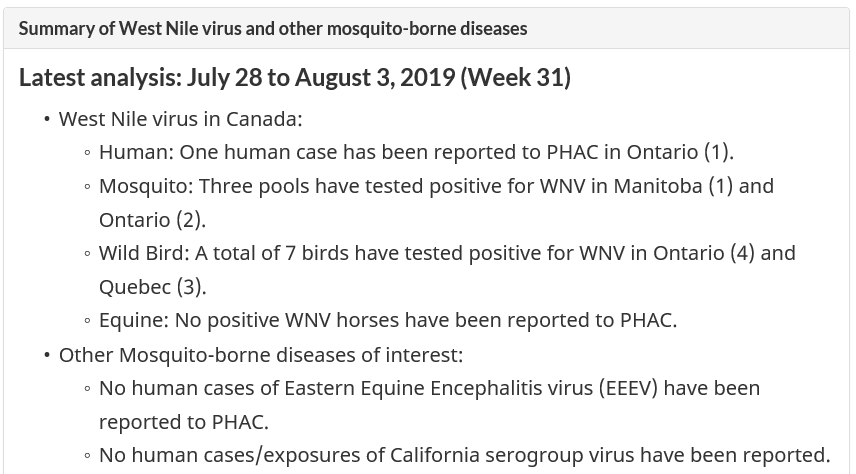
West Nile Virus Risk – Health Canada posts information related to West Nile Virus in Canada. Health Canada also tracks West Nile Virus through human, mosquito, bird and horse surveillance. Link here to access the most current weekly update (August 10, 2019). The screenshot below was retrieved 22Aug2019 as reference but access that information here.

The following is offered to predict when Culex tarsalis will begin to fly across the Canadian prairies (Fig. 1). Protect yourself by wearing DEET! This week, regions most advanced in degree-day accumulations for Culex tarsalis, the vector for West Nile Virus, are shown in the map below. As of August 18, 2019, areas highlighted orange are on the verge of approaching sufficient heat accumulation for mosquitoes to emerge. Areas highlighted red in the map below should now have C. tarsalis in flight.
Once adults emerge, the following map demonstrates how quickly a Culex tarsalis mosquito carrying WNV can become fully infective (i.e., when it has accumulated 109 base 14.3° degree days) - it's a matter of days, depending on the region (Figure 2). For example, as of August 18, 2019, areas highlighted orange in the map below had C. tarsalis flying that required 18-20 days to become fully infective.


The following is offered to predict when Culex tarsalis will begin to fly across the Canadian prairies (Fig. 1). Protect yourself by wearing DEET! This week, regions most advanced in degree-day accumulations for Culex tarsalis, the vector for West Nile Virus, are shown in the map below. As of August 18, 2019, areas highlighted orange are on the verge of approaching sufficient heat accumulation for mosquitoes to emerge. Areas highlighted red in the map below should now have C. tarsalis in flight.
 |
| Figure 1. Predicted development of Culex tarsalis, across the Canadian prairies (as of August 18, 2019). |

Friday, 16 August 2019
West Nile Virus and Culex tarsalis (August 15, 2019; Wk 19)
West Nile Virus Risk – Health Canada posts information related to West Nile Virus in Canada. Health Canada also tracks West Nile Virus through human, mosquito, bird and horse surveillance. Link here to access the most current weekly update (August 3, 2019). The screenshot below was retrieved 15Aug2019 as reference but access that information here.

The following is offered to predict when Culex tarsalis will begin to fly across the Canadian prairies (Fig. 1). Protect yourself by wearing DEET! This week, regions most advanced in degree-day accumulations for Culex tarsalis, the vector for West Nile Virus, are shown in the map below. As of August 11, 2019, areas highlighted orange are on the verge of approaching sufficient heat accumulation for mosquitoes to emerge. Areas highlighted red in the map below should now have C. tarsalis in flight.
Once adults emerge, the following map demonstrates how quickly a Culex tarsalis mosquito carrying WNV can become fully infective (i.e., when it has accumulated 109 base 14.3° degree days) - it's a matter of days, depending on the region (Figure 2). For example, as of August 11, 2019, Foremost AB was predicted to only take 16-18 days for C. tarsalis to become fully infective.

The following is offered to predict when Culex tarsalis will begin to fly across the Canadian prairies (Fig. 1). Protect yourself by wearing DEET! This week, regions most advanced in degree-day accumulations for Culex tarsalis, the vector for West Nile Virus, are shown in the map below. As of August 11, 2019, areas highlighted orange are on the verge of approaching sufficient heat accumulation for mosquitoes to emerge. Areas highlighted red in the map below should now have C. tarsalis in flight.
 |
| Figure 1. Predicted development of Culex tarsalis, across the Canadian prairies (as of August 11, 2019). |

Saturday, 10 August 2019
West Nile Virus and Culex tarsalis (August 8, 2019; Wk 18)
West Nile Virus Risk – Health Canada posts information related to West Nile Virus in Canada. Health Canada also tracks West Nile Virus through human, mosquito, bird and horse surveillance. Link here to access the most current weekly update (July 27, 2019). The screenshot below was retrieved 09Aug2019 as reference but access that information here.

The following is offered to predict when Culex tarsalis will begin to fly across the Canadian prairies (Fig. 1). Protect yourself by wearing DEET! This week, regions most advanced in degree-day accumulations for Culex tarsalis, the vector for West Nile Virus, are shown in the map below. As of July 28, 2019, areas highlighted orange are on the verge of approaching sufficient heat accumulation for mosquitoes to emerge. Areas highlighted red in the map below should now have C. tarsalis in flight.
Once adults emerge, the following map demonstrates how quickly a Culex tarsalis mosquito carrying WNV can become fully infective (i.e., when it has accumulated 109 base 14.3° degree days) - it's a matter of days, depending on the region (Figure 2). For example, as of August 8, 2019, Winnipeg MB was predicted to only take 16-18 days for C. tarsalis to become fully infective.


The following is offered to predict when Culex tarsalis will begin to fly across the Canadian prairies (Fig. 1). Protect yourself by wearing DEET! This week, regions most advanced in degree-day accumulations for Culex tarsalis, the vector for West Nile Virus, are shown in the map below. As of July 28, 2019, areas highlighted orange are on the verge of approaching sufficient heat accumulation for mosquitoes to emerge. Areas highlighted red in the map below should now have C. tarsalis in flight.
 |
| Figure 1. Predicted development of Culex tarsalis, across the Canadian prairies (as of August 5, 2019). |
Once adults emerge, the following map demonstrates how quickly a Culex tarsalis mosquito carrying WNV can become fully infective (i.e., when it has accumulated 109 base 14.3° degree days) - it's a matter of days, depending on the region (Figure 2). For example, as of August 8, 2019, Winnipeg MB was predicted to only take 16-18 days for C. tarsalis to become fully infective.

Friday, 2 August 2019
West Nile Virus and Culex tarsalis (August 1, 2019; Wk 17)
West Nile Virus Risk – Health Canada posts information related to West Nile Virus in Canada. Health Canada also tracks West Nile Virus through human, mosquito, bird and horse surveillance. Link here to access the most current weekly update (July 20, 2019). The screenshot below was retrieved 01Aug2019 as reference but access that information here.

The following is offered to predict when Culex tarsalis will begin to fly across the Canadian prairies (Fig. 1). Protect yourself by wearing DEET! This week, regions most advanced in degree-day accumulations for Culex tarsalis, the vector for West Nile Virus, are shown in the map below. As of July 28, 2019, areas highlighted orange are on the verge of approaching sufficient heat accumulation for mosquitoes to emerge. Areas highlighted red in the map below should now have C. tarsalis in flight.
Once adults emerge, the following map demonstrates how quickly a Culex tarsalis mosquito carrying WNV can become fully infective (i.e., when it has accumulated 109 base 14.3° degree days) - it's a matter of days, depending on the region (Figure 2). For example, as of July 28, 2019, Altona MB is predicted to only take 16 days for C. tarsalis to become fully infective!


The following is offered to predict when Culex tarsalis will begin to fly across the Canadian prairies (Fig. 1). Protect yourself by wearing DEET! This week, regions most advanced in degree-day accumulations for Culex tarsalis, the vector for West Nile Virus, are shown in the map below. As of July 28, 2019, areas highlighted orange are on the verge of approaching sufficient heat accumulation for mosquitoes to emerge. Areas highlighted red in the map below should now have C. tarsalis in flight.
 |
| Figure 1. Predicted development of Culex tarsalis, across the Canadian prairies (as of July 28, 2019). |

Friday, 26 July 2019
West Nile Virus and Culex tarsalis (July 25, 2019; Wk 16)
West Nile Virus Risk – Health Canada posts information related to West Nile Virus in Canada. Health Canada also tracks West Nile Virus through human, mosquito, bird and horse surveillance. Link here to access the most current weekly update (July 13, 2019). The screenshot below was retrieved 25Jul2019 as reference but access that information here.

The following is offered to predict when Culex tarsalis will begin to fly across the Canadian prairies (Fig. 1). Protect yourself by wearing DEET! This week, regions most advanced in degree-day accumulations for Culex tarsalis, the vector for West Nile Virus, are shown in the map below. Areas highlighted yellow in the map below (Fig. 2) are on the verge of approaching sufficient heat accumulation for mosquitoes to emerge. Areas highlighted lime green should be preparing for C. tarsalis flight.
Once adults emerge, the following map demonstrates how quickly a Culex tarsalis mosquito carrying WNV can become fully infective (i.e., when it has accumulated 109 base 14.3° degree days) - it's a matter of days, depending on the region (Figure 2).


 |
| Figure 1. Predicted development of Culex tarsalis, across the Canadian prairies (as of July 21 2019). |
Once adults emerge, the following map demonstrates how quickly a Culex tarsalis mosquito carrying WNV can become fully infective (i.e., when it has accumulated 109 base 14.3° degree days) - it's a matter of days, depending on the region (Figure 2).

Thursday, 18 July 2019
West Nile Virus and Culex tarsalis (July 18, 2019; Wk 15)
West Nile Virus Risk – Reminder - In 2018, there were 426 human clinical cases of West Nile virus (WNV) in Canada (Fig. 1).
Health Canada posts information related to West Nile Virus in Canada. Health Canada also tracks WNV through human, mosquito, bird and horse surveillance. Link here to access the most current weekly update (July 6, 2019). The screenshot below was retrieved 18Jul2019 as reference but access that information here.

The Canadian Wildlife Health Cooperative compiles and posts information related to their disease surveillance for West Nile Virus in birds. Take note of the provincial distribution of positive WNV birds in 2018 (table posted below as reference).

The following is offered to predict when Culex tarsalis will begin to fly across the Canadian prairies (Fig. 2). Protect yourself by wearing DEET! This week, regions most advanced in degree-day accumulations for Culex tarsalis, the vector for West Nile Virus, are shown in the map below. Areas highlighted yellow in the map below (Fig. 2) are on the verge of approaching sufficient heat accumulation for mosquitoes to emerge. Areas highlighted lime green should be preparing for C. tarsalis flight.
Once adults emerge, the following map demonstrates how quickly a Culex tarsalis mosquito carrying WNV can become fully infective (i.e., when it has accumulated 109 base 14.3° degree days) - it's a matter of days, depending on the region (Figure 3).

 |
| Figure 1. Geographic distribution of WNV human clinical cases and asymptomatic infections in Canada, 2018. Image has not been reproduced in affiliation with, or with the endorsement of the Government of Canada and was retrieved (11Jul2019). Access the full map at https://www.canada.ca/en/public-health/services/publications/diseases-conditions/west-nile-virus-surveillance/2018/november-11-december-15-week-46-50.html |
Health Canada posts information related to West Nile Virus in Canada. Health Canada also tracks WNV through human, mosquito, bird and horse surveillance. Link here to access the most current weekly update (July 6, 2019). The screenshot below was retrieved 18Jul2019 as reference but access that information here.


The following is offered to predict when Culex tarsalis will begin to fly across the Canadian prairies (Fig. 2). Protect yourself by wearing DEET! This week, regions most advanced in degree-day accumulations for Culex tarsalis, the vector for West Nile Virus, are shown in the map below. Areas highlighted yellow in the map below (Fig. 2) are on the verge of approaching sufficient heat accumulation for mosquitoes to emerge. Areas highlighted lime green should be preparing for C. tarsalis flight.
 |
| Figure 2. Predicted development of Culex tarsalis, across the Canadian prairies (as of July 14, 2019). |
Once adults emerge, the following map demonstrates how quickly a Culex tarsalis mosquito carrying WNV can become fully infective (i.e., when it has accumulated 109 base 14.3° degree days) - it's a matter of days, depending on the region (Figure 3).

Thursday, 11 July 2019
West Nile Virus and Culex tarsalis (July 11, 2019; Wk 14)
West Nile Virus Risk – In 2018, there were 426 human clinical cases of West Nile virus (WNV) in Canada (Fig. 1).
Health Canada posts information related to West Nile Virus in Canada. Health Canada also tracks WNV through human, mosquito, bird and horse surveillance. Link here to access the most current weekly update (June 29, 2019). The screenshot below was retrieved 11Jul2019 as reference but access that information here.

The Canadian Wildlife Health Cooperative compiles and posts information related to their disease surveillance for West Nile Virus in birds. Take note of the provincial distribution of positive WNV birds in 2018 (table posted below as reference).
The following is offered to predict when Culex tarsalis will begin to fly (Fig. 2) across the Canadian prairies. Protect yourself by wearing DEET! The regions most advanced in degree-day accumulations for Culex tarsalis, the vector for West Nile Virus, are shown in the map below. Areas highlighted lime green in the map below (Fig. 2) are on the verge of approaching sufficient heat accumulation for mosquitoes to emerge soon.
Once the adults emerge, the following map demonstrates how quickly a Culex tarsalis mosquito carrying WNV can become fully infective (i.e., when it has accumulated 109 base 14.3° degree days) - as quickly as 20-22 days, given the current environmental conditions in the highlighted areas of the map below (Figure 3).

|
| Figure 1. Geographic distribution of WNV human clinical cases and asymptomatic infections in Canada, 2018. Image has not been reproduced in affiliation with, or with the endorsement of the Government of Canada and was retrieved (11Jul2019). Access the full map at https://www.canada.ca/en/public-health/services/publications/diseases-conditions/west-nile-virus-surveillance/2018/november-11-december-15-week-46-50.html |
Health Canada posts information related to West Nile Virus in Canada. Health Canada also tracks WNV through human, mosquito, bird and horse surveillance. Link here to access the most current weekly update (June 29, 2019). The screenshot below was retrieved 11Jul2019 as reference but access that information here.

The following is offered to predict when Culex tarsalis will begin to fly (Fig. 2) across the Canadian prairies. Protect yourself by wearing DEET! The regions most advanced in degree-day accumulations for Culex tarsalis, the vector for West Nile Virus, are shown in the map below. Areas highlighted lime green in the map below (Fig. 2) are on the verge of approaching sufficient heat accumulation for mosquitoes to emerge soon.
 |
| Figure 2. Predicted development of Culex tarsalis, across the Canadian prairies (as of July 7, 2019). |
Once the adults emerge, the following map demonstrates how quickly a Culex tarsalis mosquito carrying WNV can become fully infective (i.e., when it has accumulated 109 base 14.3° degree days) - as quickly as 20-22 days, given the current environmental conditions in the highlighted areas of the map below (Figure 3).

Wednesday, 1 August 2018
West Nile Virus and Culex tarsalis (Aug 02, 2018; Wk 13)
West Nile Virus Risk – The regions most advanced in degree-day accumulations for Culex tarsalis, the vector for West Nile Virus, are shown in the map below. Areas highlighted yellow then orange are approaching sufficient heat accumulation for mosquitoes to emerge while mosquitoes will be flying in areas in red so wear DEET to stay protected!

Health Canada posts information related to West Nile Virus in Canada. Health Canada also tracks WNV through human, mosquito, bird and horse surveillance. Link here to access the most current weekly update (July 7, 2018) on 2018 testing (screenshot retrieved 25Jul2018 provided below for reference only).

The Canadian Wildlife Health Cooperative compiles and posts information related to their disease surveillance for West Nile Virus in birds. As of June 28, 2018, 872 birds were examined and nine have tested positive for West Nile virus. View a screen shot of the summary of those results below:


Wednesday, 25 July 2018
West Nile Virus and Culex tarsalis (Jul 26, 2018; Wk 12)
West Nile Virus Risk – The regions most advanced in degree-day accumulations for Culex tarsalis, the vector for West Nile Virus, are shown in the map below. Areas highlighted yellow then orange are approaching sufficient heat accumulation for mosquitoes to emerge while mosquitoes will be flying in areas in red so wear DEET to stay protected!

Health Canada posts information related to West Nile Virus in Canada. Health Canada also tracks WNV through human, mosquito, bird and horse surveillance. Link here to access the most current weekly update (July 7, 2018) on 2018 testing (screenshot retrieved 25Jul2018 provided below for reference only).

Reminder - The 2017 WNV surveillance map for human cases is available here but a screenshot is posted below for reference.
The Canadian Wildlife Health Cooperative compiles and posts information related to their disease surveillance for West Nile Virus in birds. As of June 28, 2018, 642 birds were examined and zero have tested positive for West Nile virus.


Reminder - The 2017 WNV surveillance map for human cases is available here but a screenshot is posted below for reference.
 |
| Figure 1. As of surveillance week 49, ending December 9, 2017, the preliminary data indicated 197 human cases of WNV in Canada; twenty-five from Québec, 159 from Ontario, five from Manitoba, seven from Alberta, and one from British Columbia. |
Thursday, 19 July 2018
West Nile Virus and Culex tarsalis (Jul 19, 2018; Wk 11)
West Nile Virus Risk – The regions most advanced in degree-day accumulations for Culex tarsalis, the vector for West Nile Virus, are shown in the map below. Areas highlighted yellow then orange are approaching sufficient heat accumulation for mosquitoes to emerge while mosquitoes will be flying in areas in red so wear DEET to stay protected!

Health Canada posts information related to West Nile Virus in Canada. Health Canada also tracks WNV through human, mosquito, bird and horse surveillance. Link here to access the most current weekly update (June 30, 2018) on 2018 testing (screenshot retrieved 18Jul2018 provided below for reference only).

Reminder - The 2017 WNV surveillance map for human cases is available here but a screenshot is posted below for reference.
The Canadian Wildlife Health Cooperative compiles and posts information related to their disease surveillance for West Nile Virus in birds. As of June 28, 2018, 642 birds were examined and zero have tested positive for West Nile virus.

Health Canada posts information related to West Nile Virus in Canada. Health Canada also tracks WNV through human, mosquito, bird and horse surveillance. Link here to access the most current weekly update (June 30, 2018) on 2018 testing (screenshot retrieved 18Jul2018 provided below for reference only).

Reminder - The 2017 WNV surveillance map for human cases is available here but a screenshot is posted below for reference.
|
| Figure 1. As of surveillance week 49, ending December 9, 2017, the preliminary data indicated 197 human cases of WNV in Canada; twenty-five from Québec, 159 from Ontario, five from Manitoba, seven from Alberta, and one from British Columbia. |
Friday, 29 June 2018
West Nile Virus and Culex tarsalis (Jun 28, 2018; Wk 08)
West Nile Virus Risk – The regions most advanced in degree-day accumulations for Culex tarsalis, the vector for West Nile Virus, are shown in the map below. Areas highlighted yellow then orange are approaching sufficient heat accumulation for mosquitoes to emerge while mosquitoes will be flying in areas in red so wear DEET to stay protected!

Health Canada posts information related to West Nile Virus in Canada. Health Canada also tracks WNV through human, mosquito, bird and horse surveillance. The 2017 WNV surveillance map for human cases is available here but a screenshot is posted below for reference.
The Canadian Wildlife Health Cooperative compiles and posts information related to their disease surveillance for West Nile Virus in birds. As of June 28, 2018, 642 birds were examined and zero have tested positive for West Nile virus.

Health Canada posts information related to West Nile Virus in Canada. Health Canada also tracks WNV through human, mosquito, bird and horse surveillance. The 2017 WNV surveillance map for human cases is available here but a screenshot is posted below for reference.
|
| Figure 1. As of surveillance week 49, ending December 9, 2017, the preliminary data indicated 197 human cases of WNV in Canada; twenty-five from Québec, 159 from Ontario, five from Manitoba, seven from Alberta, and one from British Columbia. |
Friday, 25 August 2017
Weekly Update (Aug 24, 2017; Wk 17) - West Nile Virus and Culex tarsalis
West Nile Virus Risk – The regions most advanced in degree-day accumulations for Culex tarsalis, the vector for West Nile Virus, are shown in the map below. As of August 20, 2017, areas highlighted in red on the map below have accumulated sufficient heat for C. tarsalis to fly. Culex tarsalis are also flying in areas highlighted in red, pink or mauve so wear your DEET to stay protected! Areas highlighted orange or yellow in the map should also be preparing for C. tarsalis flight.

The Public Health Agency of Canada posts information related to West Nile Virus in Canada. The map of clinical cases of West Nile Virus in Canada in 2017 is updated through the summer (screen shot of map below). The Public Health Agency of Canada (PHAC), as of August 12, 2017, reported eight clinical cases (confirmed or probable) in Ontario and one asymptomatic infection in British Columbia. All eight cases from ON are currently unclassified and two were travel-related.

The Canadian Wildlife Health Cooperative compiles and posts information related to their disease surveillance for West Nile Virus in birds. As of August 24, 2017, 1218 birds were examined and 58 tested positive for West Nile virus; three from Saskatchewan, two from Manitoba, 15 from Ontario, and 38 from Quebec.
The Public Health Agency of Canada also monitors and posts updates on the status of WNV in Mosquitoes. As of August 12, 2017, Quebec, Ontario, Manitoba and Saskatchewan reported positive mosquito pools for West Nile Virus.
A total of 224 positive mosquito pools have been found:

The Public Health Agency of Canada posts information related to West Nile Virus in Canada. The map of clinical cases of West Nile Virus in Canada in 2017 is updated through the summer (screen shot of map below). The Public Health Agency of Canada (PHAC), as of August 12, 2017, reported eight clinical cases (confirmed or probable) in Ontario and one asymptomatic infection in British Columbia. All eight cases from ON are currently unclassified and two were travel-related.

The Public Health Agency of Canada also monitors and posts updates on the status of WNV in Mosquitoes. As of August 12, 2017, Quebec, Ontario, Manitoba and Saskatchewan reported positive mosquito pools for West Nile Virus.
A total of 224 positive mosquito pools have been found:
- 172 from Ontario [Brant County (2), Chatham-Kent (3), Durham Region (4), Eastern Ontario (3), Halton Region (15), Hamilton (4), Haliburton-Kwartha-Pine Ridge District (1), Hastings and Prince Edward Countries (7), Kingston-Frontenac and Lennox and Addington (2), Lambton (1), Middlesex-London (3), Niagara Region (7), Ottawa (11), Oxford County (1), Peel (40), Perth District (2), Peterborough County-City (1), Renfrew County and District (2), Simcoe Muskoka District (1), Toronto (31), Waterloo (2), Wellington-Dufferin-Guelph (2), Windsor-Essex County (21), and York Regional (6)];
- 35 from Manitoba [(Winnipeg (12), Southern (4), Interlake Eastern (5), and Prairie Mountain (12)];
- 9 from Quebec [Montérégie (6), Laval (1), and Mauricie-centre-du-Québec(2)];
- 8 from Saskatchewan.
Friday, 18 August 2017
Weekly Update (Aug 17, 2017; Wk 16) - West Nile Virus and Culex tarsalis
West Nile Virus Risk – The regions most advanced in degree-day accumulations for Culex tarsalis, the vector for West Nile Virus, are shown in the map below. As of August 13 2017, areas highlighted in red on the map below have accumulated sufficient heat for C. tarsalis to fly. Areas highlighted in red, orange and even yellow will have C. tarsalis flying so wear your DEET to stay protected!

The Public Health Agency of Canada posts information related to West Nile Virus in Canada. In 2016, 104 human clinical cases of West Nile Virus were reported. The map of clinical cases of West Nile Virus in Canada in 2017 is updated through the summer and three cases of viral West Nile have been reported so far (as of August 5, 2017). All cases were reported from Ontario (in Timiskaming and Windsor-Essex).
The Canadian Wildlife Health Cooperative compiles and posts information related to their disease surveillance for West Nile Virus in birds. As of August 17, 2017, 1113 birds were examined and 48 have tested positive for West Nile virus; one from Saskatchewan, two from Manitoba, 13 from Ontario, and 32 from Quebec.
The Public Health Agency of Canada also monitors and posts updates on the status of WNV in Mosquitoes. As of July 22, 2017, Quebec, Ontario, Manitoba and Saskatchewan have reports of positive mosquito pools of West Nile Virus. A total of 47 positive mosquito pools have been found:

The Public Health Agency of Canada posts information related to West Nile Virus in Canada. In 2016, 104 human clinical cases of West Nile Virus were reported. The map of clinical cases of West Nile Virus in Canada in 2017 is updated through the summer and three cases of viral West Nile have been reported so far (as of August 5, 2017). All cases were reported from Ontario (in Timiskaming and Windsor-Essex).
The Public Health Agency of Canada also monitors and posts updates on the status of WNV in Mosquitoes. As of July 22, 2017, Quebec, Ontario, Manitoba and Saskatchewan have reports of positive mosquito pools of West Nile Virus. A total of 47 positive mosquito pools have been found:
- 33 from Ontario [Peel Regional (5), Toronto (6), Halton(5), Haliburton-Kwartha-Pine Ridge District(1), Simcoe Muskoka District (1), Windsor-Essex County (6), Eastern Ontario (1), Durham Reginal (1), Hamilton (1), Haliburton-Kawarta-Pine Ridge district (1), Hastings and Prince Edward Countries (2), and York Regional (3)];
- 11 from Manitoba [(Winnipeg (3), Southern (2), Interlake eastern (1), and Prairie Mountain(5)];
- 2 from Quebec [Montérégie (1), Laval (1)], and
- 1 from Saskatchewan.
Friday, 4 August 2017
Weekly Update (Aug 03, 2017; Wk 14) - West Nile Virus and Culex tarsalis
West Nile Virus Risk – The regions most advanced in degree-day accumulations for Culex tarsalis, the vector for West Nile Virus, are shown in the map below. As of July 30, 2017, areas highlighted in red on the map below have accumulated sufficient heat for C. tarsalis to fly. Areas highlighted in red, orange and even yellow will have C. tarsalis flying so wear your DEET to stay protected!

The Public Health Agency of Canada posts information related to West Nile Virus in Canada. In 2016, 104 human clinical cases of West Nile Virus were reported. The map of clinical cases of West Nile Virus in Canada in 2017 is updated through the summer and two cases of viral West Nile have been reported so far (as of July 22, 2017). Both cases were reported from Ontario (in Timiskaming and Windsor-Essex).
The Canadian Wildlife Health Cooperative compiles and posts information related to their disease surveillance for West Nile Virus in birds. As of August 3, 2017, 964 birds were examined and 23 have tested positive for West Nile virus; two from Manitoba, eight from Ontario, and 13 from Quebec.
The Public Health Agency of Canada also monitors and posts updates on the status of WNV in Mosquitoes. As of July 22, 2017, Quebec, Ontario, Manitoba and Saskatchewan have reports of positive mosquito pools of West Nile Virus. A total of 47 positive mosquito pools have been found:

The Public Health Agency of Canada posts information related to West Nile Virus in Canada. In 2016, 104 human clinical cases of West Nile Virus were reported. The map of clinical cases of West Nile Virus in Canada in 2017 is updated through the summer and two cases of viral West Nile have been reported so far (as of July 22, 2017). Both cases were reported from Ontario (in Timiskaming and Windsor-Essex).
The Public Health Agency of Canada also monitors and posts updates on the status of WNV in Mosquitoes. As of July 22, 2017, Quebec, Ontario, Manitoba and Saskatchewan have reports of positive mosquito pools of West Nile Virus. A total of 47 positive mosquito pools have been found:
- 33 from Ontario [Peel Regional (5), Toronto (6), Halton(5), Haliburton-Kwartha-Pine Ridge District(1), Simcoe Muskoka District (1), Windsor-Essex County (6), Eastern Ontario (1), Durham Reginal (1), Hamilton (1), Haliburton-Kawarta-Pine Ridge district (1), Hastings and Prince Edward Countries (2), and York Regional (3)];
- 11 from Manitoba [(Winnipeg (3), Southern (2), Interlake eastern (1), and Prairie Mountain(5)];
- 2 from Quebec [Montérégie (1), Laval (1)], and
- 1 from Saskatchewan.
Thursday, 27 July 2017
Weekly Update (Jul 27, 2017; Wk 13) - West Nile Virus and Culex tarsalis
West Nile Virus Risk – The regions most advanced in degree-day accumulations for Culex tarsalis, the vector for West Nile Virus, are shown in the map below. As of July 23, 2017, areas highlighted in yellow on the map below have accumulated sufficient heat for the initial C. tarsalis to begin to fly. Areas highlighted in orange will have C. tarsalis flying so wear your DEET to stay protected!

The Public Health Agency of Canada posts information related to West Nile Virus in Canada. In 2016, 104 human clinical cases of West Nile Virus were reported. The map of clinical cases of West Nile Virus in Canada in 2017 is updated through the summer but zero cases of viral West Nile have been reported so far (June 25-July 15, 2017).
The Canadian Wildlife Health Cooperative compiles and posts information related to their disease surveillance for West Nile Virus in birds. As of July 20, 2017, 833 birds were examined and eight have tested positive for West Nile virus; four from Ontario, one from Saskatchewan, and one from Quebec.

The Public Health Agency of Canada posts information related to West Nile Virus in Canada. In 2016, 104 human clinical cases of West Nile Virus were reported. The map of clinical cases of West Nile Virus in Canada in 2017 is updated through the summer but zero cases of viral West Nile have been reported so far (June 25-July 15, 2017).
Subscribe to:
Posts (Atom)