Thursday, 22 August 2019

Review the 2019 WEEKLY UPDATEs!

Many thanks to all our contributors!  Access the WEEKLY UPDATE as either a series of Posts OR downloadable PDF file for the entire 2019 growing season:

Wk 1 (April 08) - Otani, Vankosky
Wk 2 (April 15) - Otani, Vankosky, Giffen, Weiss, Trudel, Mori, Olfert
Wk 3 (April 26) - Otani, Giffen, Weiss, Trudel, Olfert, Vankosky
Wk 04 (May 02) - Otani, Giffen, Weiss, Trudel, Olfert, Vankosky
Wk 05 (May 9) - Otani, Giffen, Weiss, Trudel, Turkington, Svendsen, Olfert, Vankosky
Wk 06 (May 16) - Otani, Giffen, Weiss, Trudel, Turkington, Svendsen, Barkley, Olfert, Vankosky
Wk 07 (May 23) - Otani, Weiss, Giffen, Trudel, Turkington, Svendsen, Tansey, Olfert, Vankosky
Wk 08 (May 30) - Otani, Weiss, Giffen, Trudel, Turkington, Svendsen, Parent, Mlynarek, Olfert, Vankosky
Wk 09 (June 6-7) - Otani, Weiss, Giffen, Trudel, Turkington, Svendsen, Olfert, Vankosky
Wk 10 (June 13) - Otani, Weiss, Giffen, Trudel, Turkington, Svendsen, Olfert, Vankosky
Wk 11 (June 20) - Otani, Weiss, Giffen, Trudel, Turkington, Svendsen, Jorgensen, Olfert, Vankosky
Wk 12 (June 27) - Otani, Weiss, Giffen, Trudel, Turkington, Svendsen, Olfert, Vankosky
Wk 13 (July 5) - Otani, Weiss, Giffen, Trudel, Svendsen, Olfert, Vankosky
Wk 14 (July 11) - Otani, Weiss, Giffen, Trudel, Svendsen, Olfert, Vankosky
Wk 15 (July 18) - Otani, Weiss, Giffen, Trudel, Svendsen, Olfert, Vankosky
Wk 16 (July 25) - Otani, Weiss, Giffen, Trudel, Svendsen, Olfert, Vankosky
Wk 17 (August 1) - Otani, Weiss, Giffen, Trudel, Younie, Svendsen, Olfert, Vankosky
Wk 18 (August 8) - Otani, Weiss, Giffen, Trudel, Younie, Svendsen, Olfert, Vankosky
Wk 19 (August 15) - Otani, Weiss, Giffen, Trudel, Younie, Svendsen, Olfert, Vankosky
Wk 18 (August 8) - Otani, Weiss, Giffen, Trudel, Younie, Svendsen, Olfert, Vankosky
Wk 19 (August 15) - Otani, Weiss, Giffen, Trudel, Younie, Svendsen, Olfert, Vankosky
Wk 20 (August 22) - Otani, Weiss, Giffen, Trudel, Svendsen, Iron, Olfert, Vankosky

Review the 2019 INSECT OF THE WEEK!

The 2019 Insect of the Week lineup featured species you may encounter while scouting in field crops; the initial four weeks targeted introduced species while the remaining 12 weeks featured insect doppelgangers.  Many thanks to all our contributors!

Need a refresher or simply want to keep our 2019 lineup a click away? Here's the 2019 INSECT OF THE WEEK lineup for the growing season:

WK05 (May 7) - Brown marmorated stink bug
WK06 (May 13) - Lily leaf beetle (Lilioceris lilii) and its natural enemy, Tetrastichus setifer
WK07 (May 21, 2019) - Spotted wing drosophila (Drosophila suzukii Mats.)
WK08 (May 27) - Japanese beetle (Popillia japonica)

WK09 (June 3) - Doppelgangers: Pea leaf weevil and other Sitona species
WK10 (June 10) – Doppelgangers: Bertha armyworm and clover cutworm
WK11 (June 17) - Doppelgangers: Wheat midge vs. Lauxanid
WK12  (June 24) - Doppelgangers: midge vs. parasitoid
WK13 (July 2) – Doppelgangers: Cereal leaf beetle vs. Collops beetles
WK14 (July 9) – Doppelgangers: Grasshoppers
WK15 (July 15): Doppelgangers: Lygus bug vs. Alfalfa plant bug
WK16 (July 22): Doppelgangers: Lygus bugs nymphs vs. aphids
WK17 (Jul 29) - Monarch vs. Painted Lady
WK18 (Aug 6) - Doppelgangers – Good vs. good (ladybeetle larva vs. lacewing larva)
WK19 (Aug 12) - Doppelgangers: Hoverflies vs. bees vs. yellow jacket wasps
WK20 (Aug 19) - Doppelgangers: Giant water bug vs Cockroach

Review the 2019 Cereal Rust Risk Reports - Turkington

The Prairie Crop Disease Monitoring Network (PCDMN) represents the combined effort of our prairie pathologists who work together to support in-field disease management in field crops.  

In 2019, the PCDMN released a series of weekly Cereal Rust Risk Reports throughout May and June.  Information related to trajectory events based on forecast and diagnostic wind fields and cereal rust risk is experimental, and eight reports were OFFERED TO THE PUBLIC FOR INFORMATIONAL PURPOSES ONLY:

Wk 05 (May 9 Report)
Wk 06 (May 16 Report)
Wk 07 (May 23 Report)
Wk 08 (May 30 Report)
Wk 09 (June 3 Report)
Wk 10 (June 10 Report)
Wk 11 (June 17 Report)
Wk 12 (June 24 Report)

Upcoming Meetings and Conferences (August 22, 2019; Wk 20)

Upcoming Meetings and Conferences – The following agricultural insect pest-related meetings and conferences will be held - be sure to re-confirm dates and details as events are finalized:

• October 3-5, 2019:  6th Joint Meeting: Entomological Society of Saskatchewan and Alberta.  Information is posted at: https://entsocalberta.ca/news-and-events/annual-general-meeting/ 

• October 23-25, 2019:  The 2019 Western Forum on Pest Management and associated Western Committee on Crop Pests will meet at Kelowna BC. Information and registration links are available here. 

• TBA:  Information for the upcoming Entomological Society of Manitoba Annual Meeting will be available here.

• November 13-14, 2019:  The 2019 Canola Discovery Forum will be held at Winnipeg MB.  More information is available here.  

• December 11-12, 2019:  Farming Smarter Conference and Trade Show will be held at Lethbridge AB.  More information can be accessed here.  

• January 14-15, 2020:  CropSphere Agricultural Conference will be held at TCU Place in Saskatoon SK during Crop Production Week.  More information can be accessed here.  

• January 21-23, 2020: The Manitoba Ag Days show will be held in Brandon MB. More information will be available here.  


• January 28-30, 2020:  FarmTech 2019 will be held in Edmonton AB and information is available at http://farmtechconference.com/  with registration typically opening early in November.

• October 19--21, 2020:  The Joint Annual Meeting of the Entomological Society of Canada, Entomological Society of Alberta meets at Calgary AB.  Information will be available here. 


Please send other IPM-related conference and meetings to Jennifer Otani to update this information.

Previous Posts (August 22, 2019; Wk 20)

Click to review these earlier 2019 Posts:

2019 Risk and forecast maps - Week 2

Alfalfa weevil - Week 11

Bertha armyworm (predicted development) - Week 12
Bertha armyworm (monitoring) - Week 19

Cabbage seedpod weevil - Week 11
Cereal aphid manager APP - Week 12
Cereal leaf beetle - Week 9
Crop protection guides - Week 6
Cutworms - Week 5

Diamondback moth - Week 15

Field events - Week 10
Field heroes - Week 6
Flea beetles - Week 5

Grasshoppers - Week 19

Insect scouting chart for Canola - Week 5
Insect scouting chart for Flax - Week 5

Lygus in canola - Week 18

Monarch migration - Week 13

Painted lady butterfly - Week 8
Pea leaf weevil - Week 10
Prairie Crop Disease Monitoring Network - Week 5
Preparing grains for market - Week 15

Ticks and Lyme disease - Week 4
Timely IOTW to review - Week 13

Weather Radar - Week 6
Wheat midge - Week 17
Wildfires - Week 8

Wind trajectories - Review Page for list of PDFs for Weeks 1-12

Monday, 19 August 2019

Insect of the Week (Aug 19) - Doppelgangers: Giant water bug vs Cockroach

Years ago, I was walking home from the University of Alberta campus on a September evening, watching the ground, as entomologists are wont to do, when I saw a huge insect on its back on the sidewalk. It was just off of a major crosswalk under a streetlight. Upon a quick glance, I knew it was one of two things: a giant water bug or a cockroach. Either way, I needed it for my collection, so I carefully collected it using the only container I had on hand. I say that I “carefully collected” it, because water bugs are known for their painful bite and I did not want to take any risks. From inside the container, it was clear that I had scooped up a water bug.

Giant water bugs (Lethocerus americanus) are true bugs (Hemiptera) that belong to the family Belostomatidae.  There are over 150 species of water bugs in the Belostomatidae, but most are quite large (> 2 cm). Belostomatids are usually found in ponds, lakes, or slow moving rivers and streams. They spend most of their time in the water, but disperse between bodies of water by flying (except in species that have reduced wings and are flightless), at which time they may be found around streetlights or porchlights. They are predators of other insects, small fish, snails, amphibians, and other animals that they encounter in the water. Giant water bugs use their forelegs to capture prey and then use their long beak-like proboscis to feed on their prey. First, they inject enzymes into their prey that breakdown prey tissues into a liquid. Then they feast on a liquid lunch by sucking their victim dry. Their bite can be very painful. These ‘toe-biters’ are best avoided, but they are important beneficial insects in aquatic ecosystems.

Giant water bugs can be easily mistaken for adult cockroaches (especially the American cockroach, Periplaneta americana, Blattodea: Blattidae). Both water bugs and cockroaches havelarge, oval shaped bodies that are usually brown coloured. A casual glance or quick encounter with either may lead to a case of mistaken identity. But, upon closer examination, some key differences are easy to see:
  1. Cockroaches have long, obvious antennae. Water bugs do not appear to have antennae unless closely examined.
  2. The head and eyes of water bugs are visible from above. The head and eyes of cockroaches are hidden underneath the pronotum.
  3. Cockroaches have spiny legs evolved for running and quick movement. All six of their legs look the same. Water bugs have forelegs adapted to grabbing prey (raptorial legs). Their legs are also adapted for swimming and have no obvious spines.
Cockroaches are usually classified as pests by humans, but some provide important ecosystem services (i.e. they are decomposers) and others are television and movie stars (i.e. Madagascar hissing cockroaches).


Giant water bug
cc-by-nc 4.0 Christian Schwartz
American cockroach
cc-by-nc 2.0 K. Schneider
Contributed by Dr. Meghan Vankosky (@vanbugsky). 

The case of the innocuous versus the evil twin: When making pest management decisions, be sure that the suspect is actually a pest. This can be challenge since insects often mimic each other or look very similar. An insect that looks, moves and acts like a pest may in fact be a look-alike or doppelganger.
Correctly identifying a pest enables selection of the most accurate scouting or monitoring protocol. Identification and monitoring enables the application of economic thresholds. It also enables a producer to select and apply the most effective control option(s) including method and timing of application.  For the rest of the growing season, the Insect of the Week will feature insect crop pests and their doppelgangers.

Doppelgangers may be related (e.g. same genus) or may not be related, as in the case of monarch butterflies (Danaus plexippus) and viceroys (Limenitis achrippus).  Doppelgangers are usually relatively harmless but sometimes the doppelganger is a pest yet their behaviour, lifecycle or hosts may be different.
Review previously featured insects by visiting the Insect of the Week page.

Friday, 16 August 2019

Weekly Update (August 15, 2019; Wk 19) Otani, Weiss, Giffen, Trudel, Younie, Svendsen, Olfert, Vankosky

Greetings!

Week 19 for 2019!  Please access the complete Weekly Update either as a series of Posts for Week 19 (August 15, 2019) OR a downloadable PDF. Be sure to check out the Insect of the Week - this growing season features doppelgangers to aid in-field scouting!


Questions or problems accessing the contents of this Weekly Update?  Please e-mail either Dr. Meghan Vankosky or Jennifer Otani.  Past “Weekly Updates” can be accessed on our Weekly Update page.

Subscribe to the Blog by following these easy steps!

Weather synopsis (August 15, 2019; Wk 19)

Weather synopsis – This past week (August 6-12, 2019) prairie temperatures were almost 3 °C cooler than last week (Fig. 1). The warmest temperatures were observed in southern AB and MB and eastern AB.  
Figure 1. Average temperature (°C) across the Canadian prairies the past seven days (August 6-12, 2019).

Across the prairies, 30 day (July 13- August 12, 2019; Fig. 2) average temperatures were slightly cooler than long term climate normals (Fig. 3). Temperatures were warmest across MB. 
Figure 2. Average temperature (°C) across the Canadian prairies the past 30 days (July 13-August 12, 2019).

Figure 3. Mean temperature difference (°C) from Normal observed across the Canadian prairies for the past month (July 16-August 12 2019).  Image has not been reproduced in affiliation with, or with the endorsement of the Government of Canada and was retrieved (15Aug2019).  Access the full map at http://www.agr.gc.ca/DW-GS/current-actuelles.jspx?lang=eng&jsEnabled=true

Growing season temperatures (April 1-August 12, 2019) continue to be approximately 1 °C cooler than average (Fig. 4).  
Figure 4. Average temperature (°C) across the Canadian prairies for the growing season (April 1-August 12, 2019).

Significant rainfall amounts were reported across parts of the northern Peace River region, southern AB and SK (Fig. 5). Across the prairies, rainfall amounts for the past 30 days have been lowest across the southern prairies (Fig. 6). 
Figure 5. Cumulative precipitation observed the past seven days across the Canadian prairies (August 6-12, 2019).

Figure 6. Cumulative precipitation observed the past 30 days across the Canadian prairies (July 13-August 12, 2019).

Growing season rainfall amounts (Fig. 7) have been below average across southern regions of AB and west-central SK (Fig. 8). 
Figure 7. Cumulative precipitation observed across the Canadian prairies for the growing season (April 1-August 12, 2019) .
Figure 8. Percent of average precipitation observed across the Canadian prairies for the growing season (April 1-August 14, 2019).  Image has not been reproduced in affiliation with, or with the endorsement of the Government of Canada and was retrieved (15Aug2019).  Access the full map at http://www.agr.gc.ca/DW-GS/current-actuelles.jspx?lang=eng&jsEnabled=true


The growing degree day map (GDD) (Base 5 ºC, April 1-August 11, 2019) is below (Fig. 9):


The growing degree day map (GDD) (Base 10 ºC, April 1-August 11, 2019) is below (Fig. 10):


The lowest temperatures (°C) observed the past seven days ranged from at least 12 down to below 0 °C in the map below (Fig. 11).
Figure 11. Lowest temperatures (°C) observed across the Canadian prairies the past seven days (to August 14, 2019).
Image has not been reproduced in affiliation with, or with the endorsement of the Government of Canada and was retrieved (15Aug2019).  Access the full map at http://www.agr.gc.ca/DW-GS/current-actuelles.jspx?lang=eng&jsEnabled=true

The highest temperatures (°C) observed the past seven days ranged from at least 20 up to at least 32 °C in the map below (Fig. 12).
Figure 12. Highest temperatures (°C) observed across the Canadian prairies the past seven days (to August 14, 2019).
Image has not been reproduced in affiliation with, or with the endorsement of the Government of Canada and was retrieved (15Aug2019).  Access the full map at http://www.agr.gc.ca/DW-GS/current-actuelles.jspx?lang=eng&jsEnabled=true


The maps above are all produced by Agriculture and Agri-Food Canada.  Growers can bookmark the AAFC Drought Watch Maps for the growing season.

Predicted grasshopper development (August 15, 2019; Wk 19)

Grasshopper Simulation Model Output – 
Grasshopper development is progressing and populations are primarily in the adult stage (Fig. 1). Based on model runs, approximately 65% of the population should be in the adult stage (50% last week). Grasshopper development continues to be slower than average development. Based on climate data, 80% of the population would be expected to be in adult stage. Model output indicates that oviposition has begun in southern areas prairies (Fig. 2). 
Figure 1. Predicted percent of grasshopper (Melanoplus sanguinipes) populations attaining adult stage across 
the Canadian prairies (as of August 14, 2019). 
Figure 2. Predicted overview of where oviposition has started (as of August 12, 2019).


The Insect of the Week's Doppelganger featured GRASSHOPPERS for Week 14!!  Check out the excellent nymph photos to help your in-field scouting!

Biological and monitoring information related to grasshoppers in field crops is posted by Manitoba Agriculture, Saskatchewan Agriculture, Alberta Agriculture and Forestry, the BC Ministry of Agriculture and the Prairie Pest Monitoring Network.  Also refer to the grasshopper pages within the "Field Crop and Forage Pests and their Natural Enemies in Western Canada: Identification and management field guide" which is available as a free downloadable document in either an English-enhanced or French-enhanced version.

Bertha armyworm monitoring (August 15, 2019; Wk 19)

Bertha armyworm (Lepidoptera: Mamestra configurata) - Important - Watch for updates from your provincial monitoring networks who are compiling cumulative pheromone-baited trap interceptions to assess risk levels in Alberta, Saskatchewan (updated 07Aug2019), and Manitoba (locate table on pg 6).  Regions in all three prairie provinces are reporting "uncertain" risk based on pheromone-baited unitrap cumulative counts.  

SCOUT NOW to confirm in-field larval counts and REMEMBER that LARVAL DENSITIES CAN VARY DRAMATICALLY even between adjacent fields!  Scout to protect @FieldHeroes and avoid economic losses! Use the Field Heroes' scouting guide for bertha armyworm and be sure to read more at their website!

Biological and monitoring information related to bertha armyworm in field crops is posted by the provinces of Manitoba, Saskatchewan, Alberta and the Prairie Pest Monitoring Network. Also refer to the bertha armyworm pages within the "Field Crop and Forage Pests and their Natural Enemies in Western Canada: Identification and management field guide" which is a free downloadable document as both an English-enhanced or French-enhanced version.


Refer to the PPMN Bertha armyworm monitoring protocol for help when performing in-field scouting.  Use the images below (Fig. 1) to help identify egg masses and the economically important larvae in canola.


Figure 1. Stages of bertha armyworm from egg (A), larva (B), pupa (C) to adult (D).
Photos: J. Williams (Agriculture and Agri-Food Canada).

Now is the time to do in-field scouting for this insect pest.  Review the Insect of the Week which features bertha armyworm and its doppelganger, the clover cutworm!

Wanted - Slugs in field crops (August 15, 2019; Wk 19)

This year, wet field conditions contributed to slug issues in cereals and canola.  Researchers based at the University of Alberta are seeking live slug samples from field crops.  Please take note of their collection protocol and help, if possible please!

Reminder -  Feeding channels on the upper surfaces of the flag leaf in wheat were reported and evening scouting revealed the culprit!


Figure 1. Deroceras reticulatum, the "grey field slug", on wheat growing near
Crooked Creek AB (August 2, 2018; det. Lien Luong).


Figure 2.  Flag leaf feeding damage  on wheat caused by the grey field slug (Deroceras reticulatum).
Photo taken near Crooked Creek AB on August 2, 2018, by J. Otani.

Field scouting was performed in the evening from 8:30-10:30pm.  As the temperatures decreased, the slugs moved up the wheat stems, climbing to the topside of the flag leaf and onto the wheat heads although they did not appear to feed at the developing kernels.   Wheat was hand-collected by clipping stems ~20cm above the ground to later reveal a density of 1.04 slugs per stem (n=465 stems) causing the above damage (Fig. 2). 

Specimens were forwarded to L. Luong (U of A) who identified the slugs from the above field as one species, Deroceras reticulatum, the grey field slug.  The majority were juveniles. The grey field slug is the most common to occur in the home garden.

Thanks to Dr. John Gavloski (Manitoba Agriculture) who prepared the following in relation to slugs in field crops: 
  • Slugs are a complicated problem because most general insecticides don’t work well on them.  
  • Sluggo Professional (PCP#30025) is registered for slugs in field crops. It is a bait, which must be consumed by the slugs to be effective but it could be expensive on a large field.  
  • Often insecticides don't work well on slugs and it may be related to the mucous coating slugs exude.  
  • Be wary, if an insecticide is applied, the product will likely not affect the slugs but it will kill the ground beetles and other natural enemies that prey upon or parasitize slugs and could exacerbate the slug problem.  
  • Growers using no-till or minimum till operations may consider tillage to help reduce future levels of slugs.  
Health Canada has an overview of snails relating to gardening posted here.


West Nile Virus and Culex tarsalis (August 15, 2019; Wk 19)

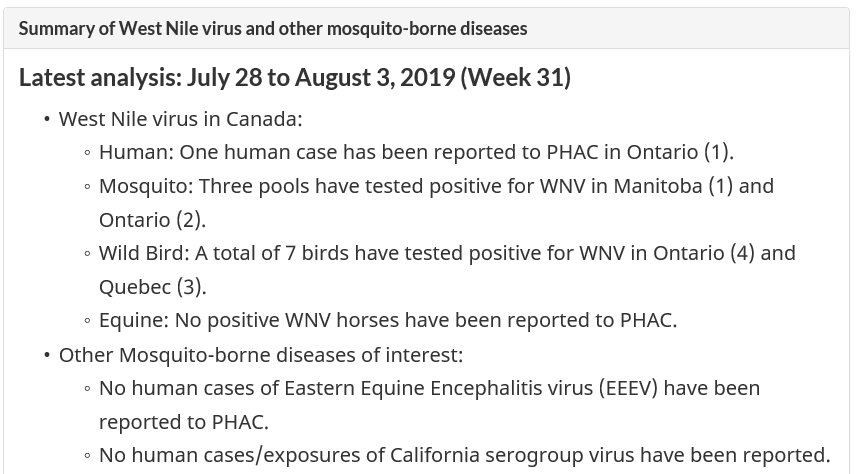
West Nile Virus Risk –  Health Canada posts information related to West Nile Virus in Canada.  Health Canada also tracks West Nile Virus through human, mosquito, bird and horse surveillance.  Link here to access the most current weekly update (August 3, 2019). The screenshot below was retrieved 15Aug2019 as reference but access that information here.


The following is offered to predict when Culex tarsalis will begin to fly across the Canadian prairies (Fig. 1). Protect yourself by wearing DEET!  This week, regions most advanced in degree-day accumulations for Culex tarsalis, the vector for West Nile Virus, are shown in the map below.  As of August 11, 2019, areas highlighted orange are on the verge of approaching sufficient heat accumulation for mosquitoes to emerge.  Areas highlighted red in the map below should now have C. tarsalis in flight.
Figure 1. Predicted development of Culex tarsalis, across the Canadian prairies (as of August 11, 2019).


Once adults emerge, the following map demonstrates how quickly a Culex tarsalis mosquito carrying WNV can become fully infective (i.e., when it has accumulated 109 base 14.3° degree days) - it's a matter of days, depending on the region (Figure 2).  For example, as of August 11, 2019, Foremost AB was predicted to only take 16-18 days for C. tarsalis to become fully infective.


Harvest Sample Program (Aug 15, 2019; Wk 19)

The Canadian Grain Commission is ready to grade grain samples harvested in 2019.  Register online to receive a harvest sample kit (by October 15, 2019).  Samples are accepted until the end of November but send as soon a harvest is complete.

This is a FREE opportunity for growers to gain unofficial insight into the quality of their grain and to obtain valuable dockage information and details associated with damage or quality issues.  The data collected also helps Canada market its grain to the world!

More information on the Harvest Sample Program is available at the Canadian Grain Commission’s website.

In exchange for your samples, the CGC assesses and provides the following unofficial results FOR FREE:

     • Unofficial grade*
     • Dockage assessment on canola
     • Protein content on barley, beans, chick peas, lentils, oats, peas and wheat
     • Oil, protein and chlorophyll content for canola
     • Oil and protein content and iodine value for flaxseed
     • Oil and protein for mustard seed and soybeans
     • Falling number for wheat
     • Vomitoxin (deoxynivalenol or DON) levels for wheat and corn

Many producers find having both grade and quality information on their samples before delivering their grain to be helpful.  Sign up for a harvest sample kit before October 15, 2019.