Provincial entomologists provide insect pest updates throughout the growing season so we have attempted to link to the most recent information provided by them:
- Manitoba's Insect preview article (April 18, 2016, published by the Manitoba Cooperator).
- Saskatchewan's Insect Pest Outlook article (April 7, 2016, published by the Western Producer).
- Watch for Alberta Agriculture and Forestry's Call of the Land for updates from Scott Meers (posted on May 19, 2016).
Thursday, 19 May 2016
Weekly Update (May 18, 2016; Wk 03) - Crop protection guide
Reminder - Crop Protection Guides – If you don’t have a copy of your province’s Crop Protection Guide, please make use of these links to access:
- Saskatchewan's Crop Protection Guide
- Manitoba's Guide to Crop Protection Guide
- Alberta's Crop Protection or Blue Book
- Western Committee on Crop Pests Guidelines for the Control of Crop Pests

Weekly Update (May 18, 2016; Wk 03) - Greetings! Otani, Giffen, Weiss, Olfert
A downloadable PDF version of the complete Weekly Update for Week 3 (May 18, 2016) can be accessed here.
Subscribe to the Blog by following the instructions posted here! You can receive automatic updates in your inbox through the growing season.

Questions or problems accessing the contents of this Weekly Update? Please e-mail either Dr. Owen Olfert or Jennifer Otani. Past “Weekly Updates” are very kindly archived to the Western Forum website by webmaster, Dr. Kelly Turkington.
Subscribe to the Blog by following the instructions posted here! You can receive automatic updates in your inbox through the growing season.

Questions or problems accessing the contents of this Weekly Update? Please e-mail either Dr. Owen Olfert or Jennifer Otani. Past “Weekly Updates” are very kindly archived to the Western Forum website by webmaster, Dr. Kelly Turkington.
Thursday, 12 May 2016
Weekly Update (May 11, 2016; Wk 02) - Greetings!
A downloadable PDF version of the complete Weekly Update for Week 2 (May 11, 2016) can be accessed here.
Subscribe to the Blog by following the instructions posted here! You can receive automatic updates in your inbox through the growing season.

Subscribe to the Blog by following the instructions posted here! You can receive automatic updates in your inbox through the growing season.

Weekly Update (May 11, 2016; Wk 02) - Weather synopsis
Across the prairies, meteorological conditions for the period of May 1-8, 2016, continued to be warm and dry.


The map below reflects the Highest Temperatures occurring over the past 7 days across the prairies.

The map below reflects the Lowest Temperatures occurring over the past 7 days across the prairies.

The maps above are all produced by Agriculture and Agri-Food Canada. Growers may wish to bookmark the AAFC Drought Watch Maps for the growing season.
The average temperature was 12.2 C and was 5 C warmer than the average temperature for May 1-8.

This past week rainfall amounts were well below normal. Average rainfall (prairie wide) was less than 1 mm.

Normal weekly rainfall is 8.7 mm. Rainfall amounts for the past 30 days (average =21 mm) were also below average (average= 28 mm).

Compared to last week, soil moisture levels were predicted to be lower.

The map below reflects the Highest Temperatures occurring over the past 7 days across the prairies.

The map below reflects the Lowest Temperatures occurring over the past 7 days across the prairies.

The maps above are all produced by Agriculture and Agri-Food Canada. Growers may wish to bookmark the AAFC Drought Watch Maps for the growing season.
Weekly Update (May 11, 2016; Wk 02) - Wind trajectories
2016 Wind Trajectories - High altitude air masses originate from southern locations and continuously move northerly to Canadian destinations. Insect pest species such as Diamondback moth and Aster leafhoppers, traditionally unable to overwinter above the 49th parallel, can utilize these air masses in the spring to move north from Mexico and the United States (southern or Pacific northwest). Data acquired from Environment Canada is compiled by Olfert et al. (AAFC-Saskatoon) to track and model spring high altitude air masses with respect to potential introductions of insect pests onto the Canadian prairies.
As of May 9, 2016, Reverse Trajectories (RTs) originating from Mexico and southwest USA have crossed most prairie locations:

Whereas Reverse Trajectories (RTs) originating from northwest USA have arrived over a greater area of the prairies with more RTs arriving in Alberta and the BC Peace:

Review the 2016 Wind Trajectory Updates in PDF format.
Weather forecasts (7 day):
Grande Prairie: https://weather.gc.ca/city/pages/ab-31_metric_e.html
Weekly Update (May 11, 2016; Wk 02) - Flea beetles
Flea Beetles (Chrysomelidae: Phyllotreta species) – Be on the lookout for flea beetle damage resulting from feeding on canola cotyledons but also on the stem.

Remember, the Action Threshold for flea beetles on canola is 25% of cotyledon leaf area consumed. Shot-hole feeding is the traditional damage in seedling canola but watch the growing point and stems of seedlings.
Refer to the flea beetle page from the new "Field Crop and Forage Pests and their Natural Enemies in Western Canada: Identification and management field guide" as an English-enhanced or French-enhanced version.

Remember, the Action Threshold for flea beetles on canola is 25% of cotyledon leaf area consumed. Shot-hole feeding is the traditional damage in seedling canola but watch the growing point and stems of seedlings.
Refer to the flea beetle page from the new "Field Crop and Forage Pests and their Natural Enemies in Western Canada: Identification and management field guide" as an English-enhanced or French-enhanced version.
Weekly Update (May 11, 2016; Wk 02) - Cutworms
Cutworms (Noctuidae) – Keep an eye on fields that are “slow” to emerge, are missing rows, include wilting or yellowing plants, have bare patches, or appear highly attractive to birds – these are areas warranting a closer look. Plan to follow-up by walking these areas later in the day when some cutworm species move above-ground to feed. Start to dig below the soil surface (1-5 cm deep) near the base of a symptomatic plant or the adjacent healthy plant. If the plant is well-established, check within the crown in addition to the adjacent soil. The culprits could be wireworms or cutworms.
Several species of cutworms can be present in fields. They range in colour from shiny opaque, to tan, to brownish-red with chevron patterning. Cutworm biology, species information, plus monitoring recommendations are available in the Prairie Pest Monitoring Network’s Cutworm Monitoring Protocol. Also refer to Manitoba Agriculture and Rural Initiatives cutworm fact sheet which includes action and economic thresholds for cutworms in several crops.
For ALBERTANS..... If cutworms are spotted in Albertan fields, please consider using the Alberta Pest Surveillance Network’s “2016 Cutworm Reporting Tool”. Once data entry occurs, your growers can view the live 2016 cutworm map.
A screen shot of the live map has been retrieved (10May2016) below for your reference.

Several species of cutworms can be present in fields. They range in colour from shiny opaque, to tan, to brownish-red with chevron patterning. Cutworm biology, species information, plus monitoring recommendations are available in the Prairie Pest Monitoring Network’s Cutworm Monitoring Protocol. Also refer to Manitoba Agriculture and Rural Initiatives cutworm fact sheet which includes action and economic thresholds for cutworms in several crops.
More information about cutworms can be found by accessing the pages from the new "Field Crop and Forage Pests and their Natural Enemies in Western Canada: Identification and Field Guide". An excerpt of ONLY Cutworm pages from the new "Field Crop and Forage Pests and their Natural Enemies in Western Canada: Identification and management field guide" as an English-enhanced or French-enhanced version.
For ALBERTANS..... If cutworms are spotted in Albertan fields, please consider using the Alberta Pest Surveillance Network’s “2016 Cutworm Reporting Tool”. Once data entry occurs, your growers can view the live 2016 cutworm map.
A screen shot of the live map has been retrieved (10May2016) below for your reference.

Remember the NEW Cutworm Field Guide is free and downloadable in 2017!
Weekly Update (May 11, 2016; Wk 02) - Cereal leaf beetle predictions
Cereal leaf beetle (Oulema melanopus) – Based on last week’s warm weather, our bioclimate model predicted rapid development of cereal leaf beetle (CLB) populations.
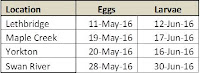
As of May 8, 2016, model indicated that oviposition is well underway and that larvae should be appearing across southern Alberta and a week later in southern Saskatchewan. Larval populations are predicted to peak in mid-June in southern Alberta and one to two weeks later at the Saskatchewan and Manitoba locations.
Predicted dates of peak emergence of CLB eggs and larvae:


Fact sheets for CLB are published by the province of Alberta and by the Prairie Pest Monitoring Network. Also access the Oulema melanopus page from the new "Field crop and forage pests and their natural enemies in western Canada - Identification and management field guide".
Predicted dates of peak emergence of CLB eggs and larvae:
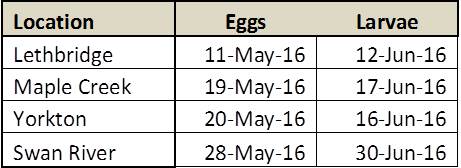
Output suggests that it’s parasitoid, Tetrastichus julis, should be emerging during the period when CLB eggs are most abundant. The model run for Swan River MB showed potential symmetry for both species, though phenologies would be two weeks later than for southern Alberta.


Fact sheets for CLB are published by the province of Alberta and by the Prairie Pest Monitoring Network. Also access the Oulema melanopus page from the new "Field crop and forage pests and their natural enemies in western Canada - Identification and management field guide".
Weekly Update (May 11, 2016; Wk 02) - Pea leaf weevil
Pea Leaf Weevil (Sitona lineatus) – Pea leaf weevils emerge in the spring primarily by flying (at temperatures above 17ºC) or they may walk short distances. Pea leaf weevil movement into peas and faba beans is achieved primarily through flight. Adults are slender, greyish-brown measuring approximately 5 mm in length.
The pea leaf weevil resembles the sweet clover weevil (Sitona cylindricollis) yet the former is distinguished by three light-coloured stripes extending length-wise down thorax and sometimes the abdomen (Access the Pea leaf weevil monitoring protocol). All species of Sitona, including the pea leaf weevil, have a short snout.

Adults will feed upon the leaf margins and growing points of legume seedlings (alfalfa, clover, dry beans, faba beans, peas) and produce a characteristic, scalloped (notched) edge. Females lay 1000 to 1500 eggs in the soil either near or on developing pea or faba bean plants from May to June.
Information related to Pea leaf weevil in Alberta and the forecast for 2016 is posted here.
The pea leaf weevil resembles the sweet clover weevil (Sitona cylindricollis) yet the former is distinguished by three light-coloured stripes extending length-wise down thorax and sometimes the abdomen (Access the Pea leaf weevil monitoring protocol). All species of Sitona, including the pea leaf weevil, have a short snout.

Adults will feed upon the leaf margins and growing points of legume seedlings (alfalfa, clover, dry beans, faba beans, peas) and produce a characteristic, scalloped (notched) edge. Females lay 1000 to 1500 eggs in the soil either near or on developing pea or faba bean plants from May to June.
Weekly Update (May 11, 2016; Wk 02) - Predicted Grasshopper Development
Grasshoppers (Acrididae) – Warm conditions over the past seven days have resulted in rapid grasshopper development. Predicted mean embryological development was 74% (last week was 62%) with greatest development predicted to be in southern AB. Embryological development is predicted to be 16% ahead of long term average values (prairie wide). The model predicts that 4% of the hatch is complete (AB, SK and MB).


Recall that the 2016 Grasshopper Forecast Map circulated in January predicted the following risk areas.

Biological and monitoring information related to grasshoppers in field crops is posted by the provinces of Manitoba, Saskatchewan, Alberta, British Columbia and the Prairie Pest Monitoring Network. Also refer to the grasshopper pages within the new "Field Crop and Forage Pests and their Natural Enemies in Western Canada: Identification and management field guide" - both English-enhanced or French-enhanced versions are available.
Weekly Update (May 11, 2016; Wk 02) - Crop protection guide
Crop Protection Guides – If you don’t have a copy of your province’s Crop Protection Guide, please make use of these links to access:
- Saskatchewan's Crop Protection Guide
- Manitoba's Guide to Crop Protection Guide
- Alberta's Crop Protection or Blue Book
- Western Committee on Crop Pests Guidelines for the Control of Crop Pests
Weekly Update (May 11, 2016; Wk 02) - Crop reports
Crop reports are produced by:
International reports are produced by:
- Manitoba Agriculture, Rural Development (May 9, 2016)
- Saskatchewan Agriculture Crop Report (April 26-May 2, 2016)
- Alberta Agriculture and Forestry (for May 3, 2016)
International reports are produced by:
- The United States Department of Agriculture's Crop Progress Report (May 9, 2016)
- The European Commission's Agriculture and Rural Development report on Short-term Outlook for EU Arable Crops, Dairy and Meat Markets.
Tuesday, 10 May 2016
2016 Wind Trajectories (May 5-9, 2016)
THE WEEK OF MAY 9, 2016: Wind trajectory data processing by AAFC-Saskatoon Staff began in April. Reverse Trajectories track arriving air masses back to their point of origin while Forward Trajectories predict favourable winds expected to arrive across the Canadian Prairies for the week of May 9, 2016:
Reverse trajectories (RT)
Naicam, Regina, Tisdale (Saskatchewan) and Lethbridge, Beiseker (Alberta) had the first occurrences of Reverse Trajectories this week that originated from southwestern USA and /or Mexico.

Forward Trajectories (FT)
There are four forward trajectories from California and Texas that are predicted to cross the prairies over the next 5 days. Below is a map of the sites from which the Forward Trajectories originated that crossed the prairies over the past month.

Review the 2016 Wind Trajectory Updates in PDF format.
Weather forecasts (7 day):
Winnipeg: https://weather.gc.ca/city/pages/mb-38_metric_e.html
Brandon: https://weather.gc.ca/city/pages/mb-52_metric_e.html
Saskatoon: https://weather.gc.ca/city/pages/sk-40_metric_e.html
Regina: https://weather.gc.ca/city/pages/sk-32_metric_e.html
Edmonton: https://weather.gc.ca/city/pages/ab-50_metric_e.html
Lethbridge: https://weather.gc.ca/city/pages/ab-30_metric_e.html
Grande Prairie: https://weather.gc.ca/city/pages/ab-31_metric_e.html
Reverse trajectories (RT)
Naicam, Regina, Tisdale (Saskatchewan) and Lethbridge, Beiseker (Alberta) had the first occurrences of Reverse Trajectories this week that originated from southwestern USA and /or Mexico.

Forward Trajectories (FT)
There are four forward trajectories from California and Texas that are predicted to cross the prairies over the next 5 days. Below is a map of the sites from which the Forward Trajectories originated that crossed the prairies over the past month.

Review the 2016 Wind Trajectory Updates in PDF format.
Weather forecasts (7 day):
Winnipeg: https://weather.gc.ca/city/pages/mb-38_metric_e.html
Brandon: https://weather.gc.ca/city/pages/mb-52_metric_e.html
Saskatoon: https://weather.gc.ca/city/pages/sk-40_metric_e.html
Regina: https://weather.gc.ca/city/pages/sk-32_metric_e.html
Edmonton: https://weather.gc.ca/city/pages/ab-50_metric_e.html
Lethbridge: https://weather.gc.ca/city/pages/ab-30_metric_e.html
Grande Prairie: https://weather.gc.ca/city/pages/ab-31_metric_e.html
Friday, 6 May 2016
Weekly Update (May 5, 2016; Wk 01) - Welcome Back!
The Weekly Update is back for the 2016 growing season in Blog form!
A downloadable PDF version of the complete Weekly Update for Week 1 (May 5, 2016) can be accessed here.

A downloadable PDF version of the complete Weekly Update for Week 1 (May 5, 2016) can be accessed here.

Weekly Update (May 5, 2016; Wk 01) - Weather synopsis
We begin with a synopsis of the weather situation starting with the map below which reflects the Accumulated Precipitation received during the winter (Nov 1, 2015 to Mar 31, 2016) across the prairies.

In terms of Percent of Average Precipitation received during the winter (Nov 1, 2015 to Mar 31, 2016), the map below confirms the lower levels of precipitation received across the prairies the past winter.

Across the prairies, meteorological conditions have been warm and dry during April. The map below indicates the Average Temperatures across the prairies (April 1-30, 2016).

The map below reflects the Highest Temperatures occurring over the past 7 days across the prairies.

And the map below reflects the Lowest Temperatures occurring over the past 7 days across the prairies.

Alberta has been particularly dry in April. The map below reflects the Accumulated Precipitation (April 1-30, 2016).

The Accumulated Precipitation the past 7 days (i.e., April 27-May 3, 2016) is mapped below:

The maps above are all produced by Agriculture and Agri-Food Canada. Growers may wish to bookmark the AAFC Drought Watch webpage.

In terms of Percent of Average Precipitation received during the winter (Nov 1, 2015 to Mar 31, 2016), the map below confirms the lower levels of precipitation received across the prairies the past winter.

Across the prairies, meteorological conditions have been warm and dry during April. The map below indicates the Average Temperatures across the prairies (April 1-30, 2016).

The map below reflects the Highest Temperatures occurring over the past 7 days across the prairies.

And the map below reflects the Lowest Temperatures occurring over the past 7 days across the prairies.


The Accumulated Precipitation the past 7 days (i.e., April 27-May 3, 2016) is mapped below:

The maps above are all produced by Agriculture and Agri-Food Canada. Growers may wish to bookmark the AAFC Drought Watch webpage.
Weekly Update (May 5, 2016; Wk 01) - Wind trajectories
2016 Wind Trajectories - High altitude air masses originate from southern locations and continuously move northerly to Canadian destinations. Insect pest species such as Diamondback moth and Aster leafhoppers, traditionally unable to overwinter above the 49th parallel, can utilize these air masses in the spring to move north from Mexico and the United States (southern or Pacific northwest). Data acquired from Environment Canada is compiled by Olfert et al. (AAFC-Saskatoon) to track and model spring high altitude air masses with respect to potential introductions of insect pests onto the Canadian prairies.
Reverse Trajectories track arriving air masses back to their point of origin while Forward Trajectories predict favourable winds expected to arrive across the Canadian Prairies.
As of May 2, 2016, Reverse Trajectories (RTs) originating from Mexico and southwest USA have been arriving across the prairies:

Whereas Reverse Trajectories (RTs) originating from northwest USA have arrived over a greater area of the prairies with more RTs arriving in Alberta and the BC Peace:

Wind trajectory data processing by AAFC-Saskatoon Staff began in April and those reports were posted for:
Weekly Update (May 5, 2016; Wk 01) - Diamondback moth
Diamondback moth (Plutellidae: Plutella xylostella) - Pheromone traps attracting male Diamondback moths have been deployed across the prairies.

Counts will be reported by the provincial staff in Manitoba and Saskatchewan soon. Alberta Agriculture and Forestry has posted their live 2016 map reporting Diamondback moth pheromone trap interceptions. A copy of the map (retrieved May 5, 2016) is below for reference.


Counts will be reported by the provincial staff in Manitoba and Saskatchewan soon. Alberta Agriculture and Forestry has posted their live 2016 map reporting Diamondback moth pheromone trap interceptions. A copy of the map (retrieved May 5, 2016) is below for reference.

Weekly Update (May 5, 2016; Wk 01) - Cereal leaf beetle predictions
Cereal leaf beetle (Chrysomelidae: Oulema melanopus) - As of May 1, 2016, the Cereal leaf beetle (CLB) model indicates that oviposition is well underway at Lethbridge AB and Maple Creek SK. Oviposition is expected to begin this week near Swan River MB. Larval populations are predicted to peak in mid-June in southern Alberta and one to two weeks later at the Saskatchewan and Manitoba locations.
Predicted dates of peak emergence of CLB eggs and larvae are as follows:

A CLB update was posted last week on the Blog.
Fact sheets for CLB are published by the province of Alberta and by the Prairie Pest Monitoring Network. Also access the Oulema melanopus page from the new "Field crop and forage pests and their natural enemies in western Canada - Identification and management field guide".
Predicted dates of peak emergence of CLB eggs and larvae are as follows:

A CLB update was posted last week on the Blog.
Fact sheets for CLB are published by the province of Alberta and by the Prairie Pest Monitoring Network. Also access the Oulema melanopus page from the new "Field crop and forage pests and their natural enemies in western Canada - Identification and management field guide".
Weekly Update (May 5, 2016; Wk 01) - Predicted Grasshopper Development
Grasshopper Simulation Model Output – The grasshopper simulation model will be used to monitor grasshopper development across the prairies. Weekly temperature data collected across the prairies is incorporated into the simulation model which calculates estimates of grasshopper development stages based on biological parameters for Melanoplus sanguinipes (Migratory grasshopper).
Warm, dry conditions typically enhance grasshopper egg development. The predicted mean embryological development of the migratory grasshopper (Orthoptera: Melanoplus sanguinipes) was 62% this week. The greatest development was predicted to be in Alberta (note areas shaded orange).

Biological and monitoring information related to grasshoppers in field crops is posted by Manitoba Agriculture, Food and Rural Development, Saskatchewan Agriculture, Alberta Agriculture and Forestry, the BC Ministry of Agriculture and the Prairie Pest Monitoring Network. Also refer to the grasshopper pages within the new "Field Crop and Forage Pests and their Natural Enemies in Western Canada: Identification and management field guide" as an English-enhanced or French-enhanced version.
Warm, dry conditions typically enhance grasshopper egg development. The predicted mean embryological development of the migratory grasshopper (Orthoptera: Melanoplus sanguinipes) was 62% this week. The greatest development was predicted to be in Alberta (note areas shaded orange).

Biological and monitoring information related to grasshoppers in field crops is posted by Manitoba Agriculture, Food and Rural Development, Saskatchewan Agriculture, Alberta Agriculture and Forestry, the BC Ministry of Agriculture and the Prairie Pest Monitoring Network. Also refer to the grasshopper pages within the new "Field Crop and Forage Pests and their Natural Enemies in Western Canada: Identification and management field guide" as an English-enhanced or French-enhanced version.
Subscribe to:
Posts (Atom)